
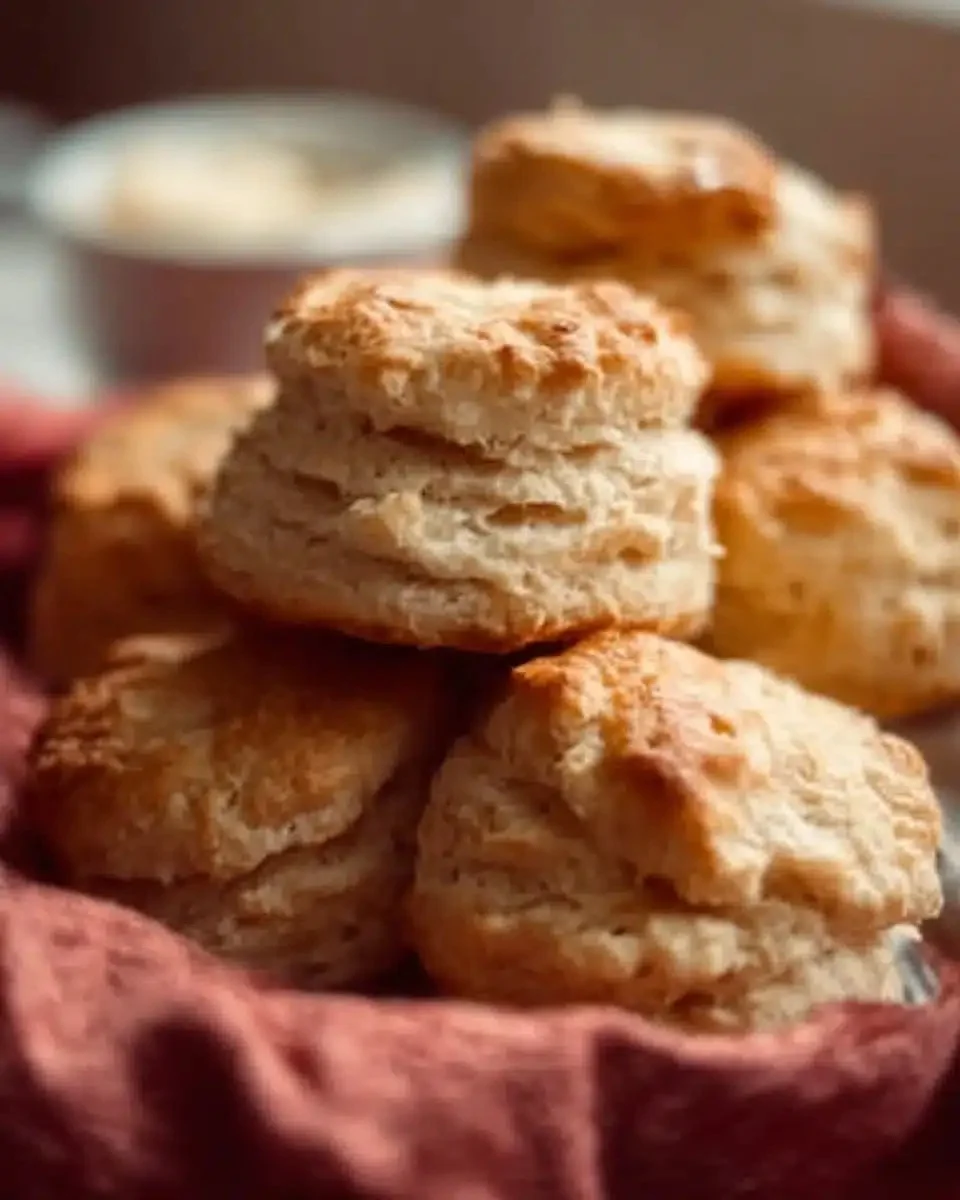
Flaky, Easy Homemade Biscuits
Warm, layered biscuits with a crisp top and soft interior melt in your mouth. I learned this method over years of weekend baking and refined it until the layers came out every time. After testing this recipe 8 times with different flours and fats, I landed on a simple fold-and-press technique that makes flaky layers without fancy tools. The secret is cold fat, minimal mixing, and a quick toss in a hot oven. Read on for precise measurements, clear steps, and practical tips so you can make bakery-style biscuits at home in about 40 minutes.
Why this recipe works
- Cold butter and a brief pulse of mixing create distinct layers as the butter steams in the oven.
- A small amount of sugar browns the crust without making the crumb sweet.
- Cutting biscuits straight down (not twisting) preserves rising because the biscuit edges stay sealed.
- Buttermilk’s acidity reacts with baking powder for lift and gives a tender crumb.
- Folding the dough 2–3 times builds flaky laminations without overworking gluten.
Ingredients breakdown
- All-purpose flour — 375 g (3 cups) all-purpose flour. Provides structure; do not swap heavily with bread flour unless you want chewier biscuits.
- Baking powder — 2 tbsp (30 ml). Primary leavening agent; make sure it’s fresh for strong rise.
- Baking soda — 1/2 tsp (2.5 ml). Works with the buttermilk’s acid to boost tenderness.
- Salt — 1 tsp (5 g). I use Diamond Crystal kosher salt; if using Morton’s, use about 3/4 tsp because it’s denser.
- Granulated sugar — 1 tbsp (12 g). Aids browning and balances flavor; omit if you prefer fully savory biscuits.
- Unsalted butter — 170 g (6 oz / 3/4 cup), very cold. Cut into 1/2-inch cubes. The butter creates steam pockets that give flakiness. You may use vegetable shortening for a different texture, but flavor will be less rich.
- Buttermilk — 240 ml (1 cup) plus extra to brush (optional). Provides acidity and moisture. If you don’t have buttermilk, combine 240 ml (1 cup) milk with 1 tbsp (15 ml) lemon juice and let sit 5 minutes.
- Egg (optional) — 1 large egg beaten with 1 tbsp (15 ml) water for an egg wash to deepen color. Skip if avoiding eggs.
Essential equipment
- Large mixing bowl and a wooden spoon or flexible spatula.
- Box grater or pastry cutter to cut cold butter into flour; a food processor is a good substitute for speed.
- 7–8 cm (2.75–3 in) round biscuit cutter or a sharp glass — do not twist when cutting.
- Baking sheet lined with parchment paper or a silicone mat.
- Cooling rack to let biscuits rest briefly after baking.
- Instant-read thermometer (helpful) to check internal doneness.
Step-by-step instructions
Prep Time 15 minutes; Cook Time 12–15 minutes; Inactive Time 15 minutes for chilling; Total Time about 42–45 minutes; Servings 8 medium biscuits.
Step 1: Chill and measure everything
Put the butter in the freezer for 10–15 minutes before you start if it’s not already very cold. Measure flour by spooning into the cup and leveling, or weigh 375 g (3 cups) for accuracy. This prevents overpacking flour. Timing: 10–15 minutes prep.
Step 2: Combine dry ingredients
In a large bowl whisk 375 g (3 cups) all-purpose flour, 2 tbsp (30 ml) baking powder, 1/2 tsp (2.5 ml) baking soda, 1 tsp (5 g) salt, and 1 tbsp (12 g) sugar until evenly distributed. This ensures even lift and flavor. Timing: about 1 minute.
Step 3: Cut in the butter
Add 170 g (6 oz / 3/4 cup) very cold butter cubes and cut them into the flour with a pastry cutter or two knives until pieces range from pea-size to coarse crumbs; you should still see visible butter bits. In a food processor, pulse 6–8 times. Do not overwork — stop when mix is shaggy. Timing: 1–2 minutes.
Step 4: Add buttermilk and form the dough
Pour 240 ml (1 cup) cold buttermilk into the flour-butter mix and stir with a spatula until the dough just comes together; it will be sticky. Do not overmix — stop as soon as no dry flour is visible. If dough feels very dry, add up to 2 tbsp (30 ml) more buttermilk. Timing: about 1 minute.
Step 5: Fold to build layers
Turn dough onto a lightly floured surface. Pat into roughly a 20 x 10 cm (8 x 4 in) rectangle about 2 cm (3/4 in) thick. Fold the rectangle in thirds like a letter, rotate 90 degrees, and pat out again to 2 cm (3/4 in). Repeat 2–3 times to create laminations. This forms flaky layers. Timing: 2–3 minutes.
Step 6: Cut biscuits and chill briefly
Press your cutter straight down and lift; do not twist. Place each round close together on a parchment-lined baking sheet so sides touch for taller biscuits. Chill on the sheet in the fridge for 10–15 minutes before baking; this firms the butter back up. Timing: 10–15 minutes inactive.
Step 7: Bake until golden
Preheat oven to 220°C (425°F). Brush tops with buttermilk or egg wash if using. Bake for 12–15 minutes until tops are golden brown and an instant-read thermometer reads ~95°C (203°F) in the center. Rotate the sheet halfway for even color. Timing: 12–15 minutes.
Step 8: Rest and serve
Remove from oven and cool on a rack 5 minutes before splitting. Serve warm with butter, jam, or gravy. Resting lets steam settle and stops carryover cooking. Timing: 5 minutes.
Expert Tips & Pro Techniques
- Chill your mixing bowl and flour for extra cold dough when it’s warm in the kitchen.
- Common mistake: twisting the cutter seals the sides and prevents rise. Press straight down and lift — no twist.
- Use a box grater to grate frozen butter for fast, even distribution if you don’t own a pastry cutter.
- Make-ahead: shape and cut the biscuits, then freeze the raw rounds on a tray. Transfer to a bag for up to 1 month and bake from frozen, adding 3–4 minutes to baking time.
- Professional technique adapted: the fold-and-press method mimics laminating. Two folds are usually enough for home bakers; too many will toughen the dough.
- If you want extra flaky layers, brush cold melted butter between folds — use sparingly, about 1 tbsp (15 ml).
Storage & reheating
- Refrigerator: Store cooled biscuits in an airtight container or zip-top bag for up to 3 days. Reheat to refresh texture.
- Freezer: Biscuits freeze well. Wrap individually in plastic and place in a freezer bag for up to 2 months. To bake from frozen, add 3–4 minutes to the bake time or thaw overnight in the fridge and reheat.
- Reheating: Best method is an oven. Reheat at 175°C (350°F) for 8–10 minutes until hot and slightly crisp. Avoid microwaving — it softens the crust and makes them gummy.
Variations & substitutions
- Gluten-Free Version: Replace 375 g (3 cups) all-purpose flour with a 1:1 gluten-free blend (such as Bob’s Red Mill). Add 1/2 tsp xanthan gum. Baking time may increase by 2–4 minutes.
- Vegan Version: Substitute buttermilk with 1 cup unsweetened plant milk + 1 tbsp lemon juice, and replace butter with 170 g (3/4 cup) vegan shortening. Texture will be slightly different and less rich.
- Cheddar & Chive: Fold 100 g (1 cup) grated sharp cheddar and 2 tbsp (8 g) minced chives into the dough before folding. Keep buttermilk measure the same. Bake as directed.
- Drop Biscuits (no cutting): Omit rolling and cutting. Use a 60 ml (1/4 cup) scoop per biscuit, drop onto the sheet, and bake 13–16 minutes. They’re quicker but have fewer layers.
- Shortcut Using Frozen Biscuits: For a faster breakfast, use frozen raw biscuits and bake straight from frozen, increasing time by 3–5 minutes.
Serving suggestions & pairings
- Classic breakfast: Split warm biscuits and serve with honeyed butter and a soft-boiled egg.
- Savory plate: Use as a base for sausage gravy or biscuit sandwiches with fried chicken.
- Side for soups: These biscuits go well with thick stews and chowders; try pairing with an easy homemade mounjaro recipe for a hearty meal.
- Brunch board: Add preserves, sharp cheddar, and sliced ham and serve with tasty char siu chicken for a fusion spread.
Nutrition information (per serving)
Serving size: 1 biscuit (recipe makes 8)
- Calories: 230 kcal
- Total Fat: 12 g
- Saturated Fat: 7 g
- Cholesterol: 40 mg
- Sodium: 360 mg
- Total Carbohydrates: 25 g
- Dietary Fiber: 1 g
- Sugars: 2 g
- Protein: 4 g
Nutrition values are estimates. Actual values may vary based on specific ingredients and preparation methods.
Frequently asked questions
Q: Why did my biscuits turn out dense?
A: Dense biscuits usually mean too much mixing or too little fat. Mix only until the dough just comes together and keep butter very cold.
Q: Can I make this without eggs?
A: Yes. The egg is optional and used only for an egg wash. The dough itself does not require eggs.
Q: Can I double this recipe?
A: Yes. You can double the ingredients and mix in a larger bowl. Bake on two sheets to avoid crowding and ensure even heat.
Q: Can I prepare the dough the night before?
A: Yes. Mix through the cutting step, shape the dough into a disk, wrap tightly, and refrigerate up to 24 hours. Cut and bake cold the next day.
Q: How long do biscuits keep in the fridge?
A: Stored in an airtight container, biscuits keep 2–3 days in the refrigerator.
Q: Will using salted butter change the result?
A: Salted butter will increase sodium. Reduce added salt to 1/2 tsp (2.5 g) if using salted butter.
Q: Can I use milk instead of buttermilk?
A: You can, but add 1 tbsp (15 ml) lemon juice or vinegar to 240 ml (1 cup) milk and let it sit 5 minutes to mimic acidity and tenderness.
Conclusion
These biscuits rely on cold butter, minimal mixing, and a quick fold to create flaky, tender layers. For a classic homestyle take that inspired many bakers, see Grandma’s Flaky Buttermilk Biscuits – Cooking Maniac for a vintage perspective and technique notes. If you want a very quick, straightforward method to compare results, check Ridiculously Easy Buttermilk Biscuits – The Café Sucre Farine for a simple shortcut approach.
Print
Flaky, Easy Homemade Biscuits
- Total Time: 45 minutes
- Yield: 8 medium biscuits 1x
- Diet: Vegetarian
Description
Warm, layered biscuits with a crisp top and soft interior melt in your mouth. This method creates flaky layers without fancy tools.
Ingredients
- 375 g (3 cups) all-purpose flour
- 2 tbsp (30 ml) baking powder
- 1/2 tsp (2.5 ml) baking soda
- 1 tsp (5 g) salt
- 1 tbsp (12 g) granulated sugar
- 170 g (6 oz / 3/4 cup) very cold unsalted butter, cut into cubes
- 240 ml (1 cup) buttermilk, plus extra to brush
- 1 large egg (optional, for egg wash)
Instructions
- Chill and measure everything.
- Combine dry ingredients in a bowl.
- Cut in the butter until mixture resembles coarse crumbs.
- Add buttermilk and stir until dough just comes together.
- Fold the dough to build layers on a floured surface.
- Cut biscuits and chill briefly.
- Bake until golden brown.
- Rest and serve warm.
Notes
For extra flaky layers, brush cold melted butter between folds. Avoid twisting the cutter when cutting the biscuits to maintain rise.
- Prep Time: 15 minutes
- Cook Time: 15 minutes
- Category: Baking
- Method: Baking
- Cuisine: American
Nutrition
- Serving Size: 1 biscuit
- Calories: 230
- Sugar: 2g
- Sodium: 360mg
- Fat: 12g
- Saturated Fat: 7g
- Unsaturated Fat: 3g
- Trans Fat: 0g
- Carbohydrates: 25g
- Fiber: 1g
- Protein: 4g
- Cholesterol: 40mg