
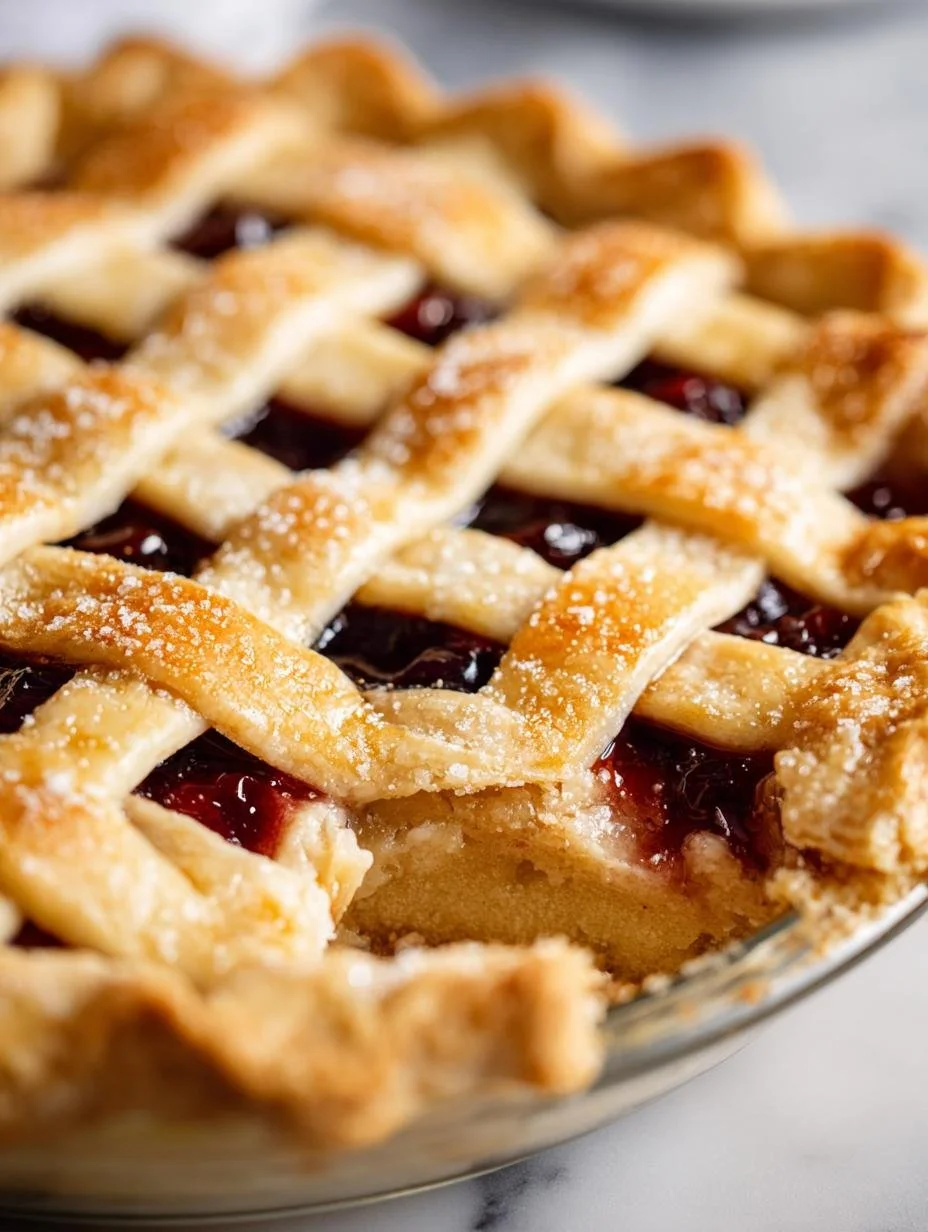
Traditional Lattice Pie Crust guide
The first time you slide a perfectly woven lattice crust into the oven, you’ll see steam bloom through a geometric web and understand why people keep coming back to this technique. This guide is a reader-first, practical manual that will take you from unsure beginner to confident pie artist. Here you’ll gain not just recipes, but reasoning: why flour behaves the way it does, how temperature shapes texture, and which small changes make a big difference.
What you will learn: the history and origin of the lattice, the core science behind pastry dough, a dependable step-by-step process, advanced techniques for speed and beauty, troubleshooting for common problems, and variations to suit fillings and occasions. Bookmark this Traditional Lattice Pie Crust guide as your go‑to reference.
Background & Context
The lattice crust is both decorative and functional. The pattern—strips of dough woven over and under—creates a breathable top that lets juices reduce and caramelize while offering an inviting, rustic look.
Classic Lattice Pie Crust history stretches back centuries, with influences from European pastry traditions where open-top pies and tarts were common. Over time, home bakers adapted the weaving method to balance aesthetics and practical venting.
Understanding the Authentic Lattice Pie Crust origin helps you respect the craft: lattices were practical—allowing steam to escape—and signaling rustic abundance at communal tables.
I’ve watched home cooks transform awkward strips into elegant patterns countless times. The most important change I’ve seen is confidence: once you understand the why, the how becomes fluent.
Why This Approach Works
This guide prioritizes explanation over prescription. You’ll see not just what to do, but why each step matters.
- Predictable results: By aligning temperature control, hydration, and handling, you get consistent texture—flaky but not crumbly.
- Flexible for different skill levels: Beginners get concrete steps; intermediates refine technique; advanced bakers get efficiency tips.
- Practical and real-world: Methods accommodate household tools and time constraints without compromising quality.
Common doubts addressed: “Is lattice just for looks?” No—venting and crust thickness impact filling texture. “Do I need special tools?” No—pasta rollers and pie shapers help but aren’t necessary.
Core Concepts Explained
Break the process into core components so each part makes sense.
- Dough composition: flour, fat, water, salt, and sometimes sugar or vinegar. Fat type (butter, shortening, lard) affects flavor and flakiness.
- Temperature & hydration: cold fat yields layers; correct water binds without activating too much gluten.
- Handling: minimal manipulation prevents toughness. Resting relaxes gluten and solidifies fat.
- Rolling & cutting: uniform thickness and strip width determine bake time and look.
- Weaving: tension control prevents stretching and tearing.
Examples:
- If you want a rich flavor, use mostly butter with a small proportion of shortening for structure.
- If your kitchen is warm, chill the bowl, tools, and dough frequently.
Alternatives and substitutions:
- Gluten-free flours: use a blend and add xanthan or psyllium for elasticity.
- Vegan fats: coconut oil can substitute but adjust water since it behaves differently at room temperature.
Tools, Resources, or Foundations
Essentials:
- Good mixing bowl
- Pastry blender or two forks (or food processor)
- Rolling pin
- Sharp knife or pastry wheel
- Measuring cups/spoons and a digital scale (recommended)
Useful optional enhancements:
- Dough scraper for clean handling
- Ruler or straight edge for uniform strips
- Pastry mat with measurements
- Pie bird or steam vents when not using a full lattice
Budget-friendly alternatives:
- Use your hands instead of a pastry cutter.
- Chop cold butter into cubes and toss with flour by hand.
- A cleaned cereal box can act as a straightedge for cutting strips.
Why these choices matter: the right tools reduce frustration and speed learning, but none are mandatory. The technique is the priority.
Step-by-Step Process
This section walks you through a dependable method. Time estimates are included for planning.
Total active time: ~45–60 minutes. Passive chilling/rest: 1–2 hours (can be overnight).
Step 1 — Make the Dough (15 minutes active; 1 hour chill)
Ingredients for a single 9-inch double crust:
- 2 1/2 cups (312 g) all-purpose flour
- 1 teaspoon salt
- 1 tablespoon sugar (optional)
- 1 cup (226 g) cold unsalted butter, cubed
- 6–8 tablespoons ice water
Process:
- Whisk flour, salt, and sugar.
- Cut in butter until pea-sized bits remain.
- Add ice water one tablespoon at a time until dough barely comes together.
- Form two discs, wrap, and chill 1 hour.
Why: Cold fat creates pockets that steam into flaky layers. Overworking develops gluten and makes a tough crust.
Common mistake: Adding too much water. Solution: Use just enough to bring dough together; if it’s sticky refrigerate briefly.
Step 2 — Prepare Filling and Preheat (10–20 minutes depending on filling)
Prepare your fruit filling while dough chills. Preheat oven to 375°F (190°C) or as your recipe requires.
Time tip: Pre-cooking juicy fillings slightly reduces excessive bubbling.
Step 3 — Roll Bottom Crust (5–10 minutes)
Roll one disc on a lightly floured surface to a circle about 12–13 inches across and 1/8 inch thick. Transfer to pie dish with minimal stretching.
Why minimal stretching? Stretching will shrink back during baking, distorting the lattice.
Pro tip: Roll from the center outward; rotate frequently for an even circle.
Step 4 — Cut Lattice Strips (10 minutes)
Options:
- Knife: yields rustic edge.
- Pastry wheel: smoother edge.
- Ruler for uniform width (commonly 1/2 to 3/4 inch).
Technique:
- Roll the second dough disc to similar thickness.
- Cut strips lengthwise; keep them on a lightly floured surface.
- If strips get warm, return to fridge briefly.
Time estimate: 10 minutes for 10–12 strips.
Step 5 — Weave the Lattice (10–15 minutes)
This step benefits from calm and patience.
Method:
- Lay 5–6 parallel strips across the filled pie, spaced evenly.
- Fold back alternating strips halfway and place a strip perpendicular.
- Unfold the folded strips over the new strip.
- Fold back the alternate set and place the next perpendicular strip.
- Repeat until the lattice is complete.
Why it works: Alternating fold/unfold creates the woven pattern without stretching strips.
Pro tips:
- Use a ruler to keep spacing consistent.
- Work quickly to keep dough cool.
- If a strip breaks, patch with a small dough piece and smooth the seam.
Step 6 — Trim and Crimp (5 minutes)
Trim strips flush to rim. Tuck ends under the bottom crust edge and press to seal. Crimp with fingers or a fork.
Why: Sealing prevents filling leaks and gives a finished look.
Step 7 — Egg Wash and Baking (20–60 minutes)
Egg wash: 1 egg beaten with 1 tablespoon water. Brush lightly.
Baking time varies:
- Fruit pies: 45–60 minutes at 375°F, cover edge with foil if browning too fast.
- Lattice allows more evaporation; some pies bake faster.
Indicator: Filling bubbles through lattice and crust is golden brown.
Cooling: Let pie cool at least 2 hours for filling to set.
Expert Techniques & Insights
Advanced bakers will appreciate efficiency and higher-fidelity results.
- Layering for flakiness: Use “lamination” style—fold dough over itself once or twice before cutting strips for extra layers.
- Patchless repair: If a strip tears, dampen edges and press a small strip to bridge. Chill briefly before baking.
- Temperature control: Keep bowls, cutter blades, and rolling surfaces cool. Store cut strips on a sheet pan in the fridge.
- Shade baking: Use a cookie sheet on lower rack to avoid bottom burning when lattice venting increases surface browning.
Lessons learned:
- Visual consistency trumps precise measurements in weaving; even strips create balance.
- Practice on a cold day if you’re learning—the dough behaves more predictably.
Variations & Adaptations
The lattice adapts to fillings and design intent.
- Half-lattice: Use lattice only over the center and leave rims solid for decorative cutouts.
- Misaligned lattice: Staggered strips create a rustic look for fall pies.
- Thin lattice: Narrow 1/4-inch strips for delicate tarts; use a higher butter ratio.
- Thick lattice: Bold, wide strips for fruit pies with a lot of juice.
- Savory lattice: Use for pot pies with herb-infused dough; reduce sugar and brush with milk instead of egg.
Skill-level adaptations:
- Beginner: Two simple parallel strips forming a cage.
- Intermediate: Full woven lattice with consistent spacing.
- Advanced: Decorative lattices—braids, double-twist strips, or cutouts interwoven.
Cultural flexibility:
- Use lattice on fruit pies globally—apple, cherry, berry—as well as on galettes and regional open tarts.
Analysis & Benefits Breakdown
A clear table helps compare lattice attributes against full top crusts and open-faced pies.
| Feature | Lattice Crust | Full Top Crust | Open Top (no crust) |
|—|—:|—:|—:|
| Venting / evaporation | High | Moderate (requires vents) | Highest |
| Crust-to-filling ratio | Moderate | High | Low |
| Visual appeal | Decorative, rustic | Traditional, enclosed | Casual, exposed |
| Baking speed | Slightly faster (evaporation) | Moderate | Fast |
| Leak risk | Moderate (strips may shift) | Low (sealed) | High (no seal) |
| Best for | Juicy fruit | Thick fillings (custard) | Quick berries or tarts |
Strengths: Lattice balances appearance and practical venting, adding caramelization and texture contrast.
Limitations: More labor-intensive and may allow filling to bubble over; thickness control matters.
Considerations: Choose lattice when the goal is a showy top and when the filling will benefit from evaporation and caramelization.
Preparation, Retention & Long-Term Use
How to prepare effectively:
- Make dough the night before; chilled dough improves handling.
- Pre-portion strips and freeze between layers of parchment for quick assembly later.
Retention and reuse strategies:
- Freeze assembled pies (unbaked) for up to 3 months. Thaw in refrigerator before baking.
- Store rolled but uncut dough in the fridge up to 3 days; freeze for longer.
Longevity of skill:
- Lattice is a repeatable motor skill. Practice monthly and you’ll retain speed and judgment.
- Keep a practice strip sheet for warm-weather months to maintain skills without baking a whole pie.
Troubleshooting & Common Problems
Use this Problem → Cause → Solution format to quickly diagnose issues.
Problem: Dough is too sticky to roll.
- Cause: Too much water or warm kitchen.
- Solution: Chill dough on a sheet for 15–30 minutes; dust a bit of flour to roll; avoid adding excessive flour.
Problem: Strips shrink when baked.
- Cause: Dough was stretched when placed in pie or not chilled.
- Solution: Chill strips before assembling; avoid tugging strips when weaving.
Problem: Filling bubbles over and creates a soggy rim.
- Cause: Overly juicy filling or insufficient thickener.
- Solution: Pre-cook filling to reduce juices; add cornstarch or tapioca; place pie on a baking sheet to catch drips.
Problem: Crust browns too quickly.
- Cause: Oven too hot or strip edges too thin.
- Solution: Lower oven 10–25°F; shield edges with foil; brush lighter egg wash.
Problem: Lattice collapses or separates.
- Cause: Strips not sealed at rim or dough too warm.
- Solution: Tuck and press strips into bottom crust edge; chill assembled pie for 15–20 minutes before baking.
Problem: Tough crust.
- Cause: Overworking or too much water, too much gluten development.
- Solution: Use lighter handling, fold or press rather than knead; rest dough chilled before rolling.
FAQ Section
Q: How wide should lattice strips be?
A: Common widths are 1/2 to 3/4 inch for standard pies. Narrower strips look delicate; wider strips provide a rustic look.
Q: Can I make lattice ahead of time?
A: Yes. Cut strips can be chilled up to 3 days or frozen in layers separated by parchment for months.
Q: Is there a difference between lattice and braided tops?
A: Yes. Lattice is a woven grid; braids are decorative single-line braids laid across filling. Both vent but braid is denser.
Q: Do I need to egg wash a lattice crust?
A: Egg wash improves color and shine. For a softer finish, brush with milk. For vegan pies, use non-dairy milk or syrup.
Q: Can I bake a lattice pie from frozen?
A: Yes. Bake at a slightly lower temperature initially and allow longer time; cover edges to prevent overbrowning.
Q: What filling works best with lattice?
A: Juicy fruit fillings like apple, cherry, and berry benefit most—the lattice allows syrup to concentrate and caramelize.
Q: How to prevent soggy bottom with lattice?
A: Preheat a baking sheet on the lower rack, use a thickener in the filling, and drain excess juices when necessary.
Q: Are there decorative alternatives to weaving?
A: Yes. Use cutouts, braids, or a combination of lattice and decorative cutouts for variety.
Related Topics & Next Steps
If you enjoyed this guide, deepen your pie work with:
- Single-crust galettes and freeform tarts for minimal fuss.
- Laminated pastry techniques (puff or rough puff) for ultra-flaky results.
- Fruit preservation and sauce reduction for consistent fillings.
Skills to complement lattice:
- Dough temperature management
- Glazing and sugar finishing techniques
- Timed baking and rack placement strategies
Quick Reference Summary
- Dough: Keep fat cold; minimal water; rest before rolling.
- Strips: 1/2–3/4 inch typical; keep cool while working.
- Weave: Fold/unfold method; maintain even spacing.
- Bake: 375°F typical; watch browning; cool for filling set.
- Troubleshoot: Chill to firm, pre-cook watery fillings, use corn starch for thickening.
Pin or print this summary to keep at your workstation.
Conclusion & Engagement
You now have a full Traditional Lattice Pie Crust guide: historical context, scientific reasoning, step-by-step instructions, troubleshooting, and creative variations. Practice with a simple apple or berry filling to solidify muscle memory; shortly you’ll weave confidently without reference.
For a clear visual walkthrough, consider the video tutorial How to Lattice Pie Crust (Easy Video Tutorial) – Sally’s Baking, and for a step-by-step photo guide that complements this manual, see How to Make a Lattice Pie Crust (Step by Step) – The Food Charlatan.
If you’d like, I can convert this guide into a checklist, printable recipe card, or a short video script for kitchen practice. Which would help you most next?
Print
Traditional Lattice Pie Crust
- Total Time: 120 minutes
- Yield: 1 pie (8 servings) 1x
- Diet: Vegetarian
Description
Master the art of weaving a classic lattice pie crust with this comprehensive guide that covers everything from dough making to troubleshooting.
Ingredients
- 2 1/2 cups (312 g) all-purpose flour
- 1 teaspoon salt
- 1 tablespoon sugar (optional)
- 1 cup (226 g) cold unsalted butter, cubed
- 6–8 tablespoons ice water
Instructions
- Whisk flour, salt, and sugar.
- Cut in butter until pea-sized bits remain.
- Add ice water one tablespoon at a time until dough barely comes together.
- Form two discs, wrap, and chill for 1 hour.
- Prepare your fruit filling while dough chills and preheat oven to 375°F (190°C).
- Roll one disc on a lightly floured surface to a circle about 12–13 inches across and 1/8 inch thick.
- Roll the second dough disc to similar thickness and cut strips lengthwise.
- Lay and weave the strips over the filled pie.
- Trim and crimp the edges of the pie crust.
- Brush with egg wash and bake for 45–60 minutes.
- Let pie cool for at least 2 hours before serving.
Notes
For best results, keep the dough and tools cool while working. Use a mix of butter and shortening for a richer flavor.
- Prep Time: 60 minutes
- Cook Time: 60 minutes
- Category: Dessert
- Method: Baking
- Cuisine: American
Nutrition
- Serving Size: 1 slice
- Calories: 250
- Sugar: 1g
- Sodium: 200mg
- Fat: 15g
- Saturated Fat: 9g
- Unsaturated Fat: 6g
- Trans Fat: 0g
- Carbohydrates: 30g
- Fiber: 1g
- Protein: 3g
- Cholesterol: 30mg