
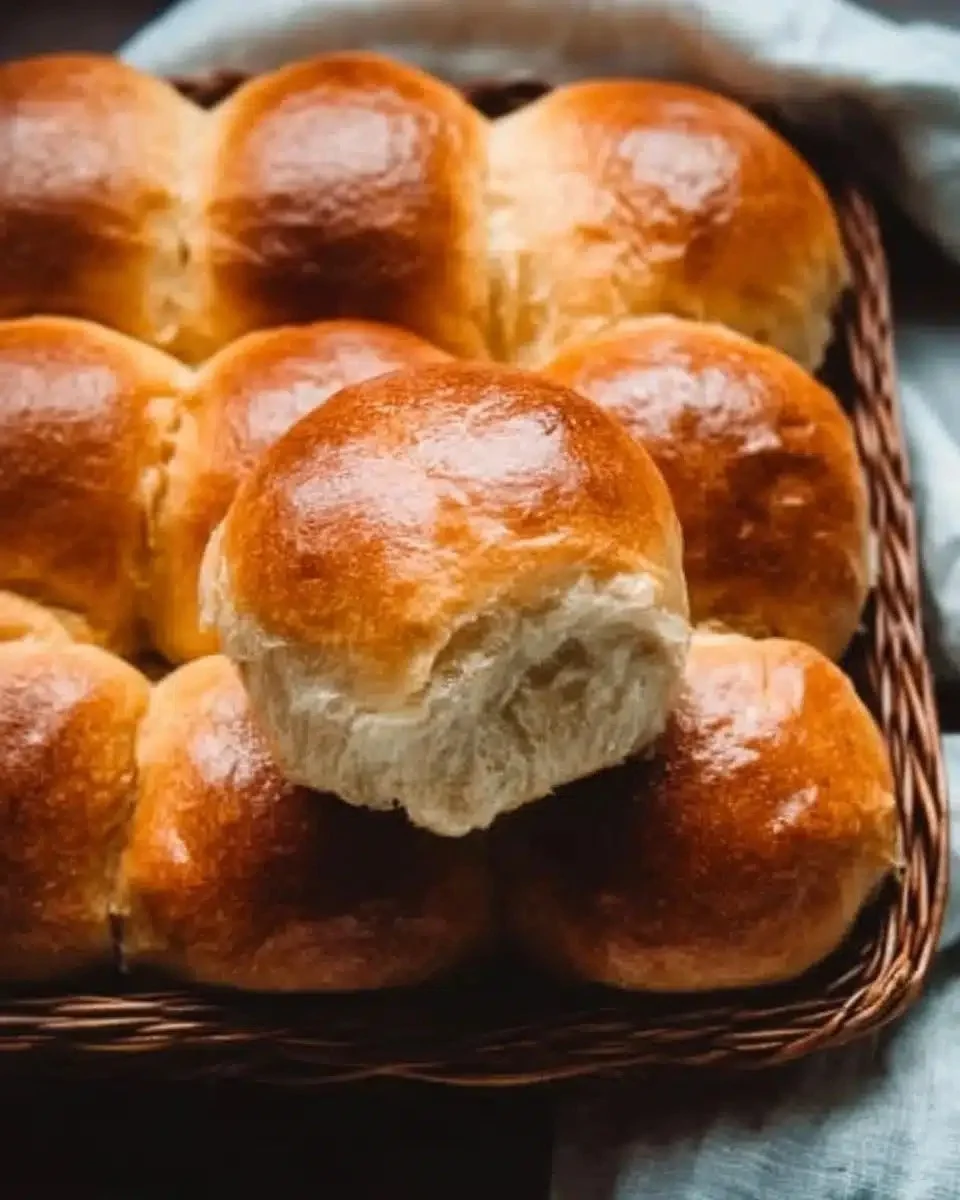
Tender, Fluffy Dinner Rolls — Easy Homemade Recipe
Warm, pillowy soft dinner rolls melt at the edges and smell like butter and yeast. I perfected this version after testing it 8 times with different flours and shaping methods so the crumb stays tender and the crust stays thin. These rolls rise overnight for better flavor, but the method still works when you need them the same day. You’ll find clear timings, exact weights, and simple tricks that professional bakers use, adapted for a home kitchen. Read on for the ingredient notes, step-by-step method, and pro tips that make these the kind of rolls guests ask for seconds of.
Why this recipe works
- Slow fermentation (a short overnight rest) improves flavor without complex sourdough techniques.
- A high-hydration dough (about 60% water by weight) creates a tender crumb that stays soft the next day.
- Enriched dough (butter and milk) keeps the crust thin and the interior rich.
- Gentle folding develops just enough gluten for structure without making rolls tough.
- Shaping into tight balls creates surface tension, so the rolls rise upward and form smooth, glossy tops.
Ingredients breakdown
- All-purpose flour — 500 g (4 cups). The main structure; use a standard protein AP flour. For lighter rolls, try bread flour, but expect a slightly chewier crumb.
- Whole milk — 240 ml (1 cup), warmed to 38°C (100°F). Adds tenderness and flavor; do not exceed 46°C (115°F) or you’ll kill the yeast.
- Warm water — 120 ml (1/2 cup), 38°C (100°F). Balances hydration; measure with a kitchen scale for accuracy.
- Instant yeast — 9 g (2 1/4 tsp). Fast, reliable rise; active dry yeast can be used but proof it first in warm water and reduce the added water slightly.
- Granulated sugar — 40 g (3 tbsp). Feeds yeast and browns the crust.
- Salt — 10 g (1 3/4 tsp). Use Diamond Crystal kosher salt for the called amounts; if you use Morton’s, use about 1 tsp (because Morton’s is denser).
- Unsalted butter — 56 g (4 tbsp), melted and cooled slightly. Adds richness and a silky crumb. You can substitute olive oil for a dairy-free version, but flavor and texture will change.
- Egg — 1 large (optional, for richer dough and better color). If omitting for an egg-free roll, increase milk by 15–30 ml (1–2 tbsp) and expect a slightly lighter color.
Substitution notes
- Dairy-free: Replace milk with equal parts unsweetened almond milk and water, and swap butter for a neutral oil. Texture will be slightly different.
- Whole-grain: Replace up to 50% flour with whole-wheat for nuttier flavor; add 15–30 ml (1–2 tbsp) extra water and expect a slightly denser roll.
- No-yeast emergency: Use 1 tsp baking powder and bake immediately — these will be more biscuit-like and lack the yeasty flavor.
Essential equipment
- Mixing bowl (large) or stand mixer with dough hook — a stand mixer speeds the process but you can mix by hand.
- Kitchen scale — for precise weights; scales improve consistency.
- Instant-read thermometer — to check milk/water temperature and final internal temp.
- 9×13-inch (23×33 cm) baking pan or similar — holds 12 rolls comfortably.
- Plastic wrap or a clean kitchen towel for proofing.
- Bench scraper — helpful for dividing dough evenly. If you don’t have one, a sharp knife will do.
Step-by-step instructions
Prep time: 30 minutes • Cook time: 18 minutes • Inactive time: 1 hour • Total time: 1 hour 48 minutes • Makes 12 rolls (serving size: 1 roll)
Step 1: Warm the liquids and bloom the yeast
Combine 240 ml (1 cup) whole milk and 120 ml (1/2 cup) warm water, heated to 38°C (100°F). Stir in 40 g (3 tbsp) sugar and sprinkle 9 g (2 1/4 tsp) instant yeast over top; let sit 3–5 minutes until foamy. If it does not foam, the yeast may be old — discard and try fresh yeast.
Step 2: Mix the dry ingredients
In a bowl, whisk 500 g (4 cups) all-purpose flour with 10 g (1 3/4 tsp) salt. Reserve about 15 g (2 tbsp) of flour for dusting. Use a scale for accuracy to avoid overly dense rolls. Mixing dry ingredients separately ensures even salt distribution.
Step 3: Form the dough
Add the foamy liquid, 1 large egg (optional), and 56 g (4 tbsp) melted butter to the dry ingredients. Mix with a stand mixer on low with a dough hook for 6–7 minutes until the dough cleans the bowl and becomes smooth, about 6–8 minutes total. If mixing by hand, stir with a wooden spoon then knead on a floured surface for 8–10 minutes until smooth. Do not over-knead — stop when the dough is elastic and slightly tacky.
Step 4: First rise
Place the dough in a lightly oiled bowl, cover tightly, and let rise at room temperature for 45–60 minutes until roughly doubled. For deeper flavor, refrigerate overnight (8–12 hours) — the slow chill counts as inactive time and improves taste. The dough should feel pillowy and slightly spring back when poked.
Step 5: Shape the rolls
Turn the dough out onto a lightly floured surface. Divide into 12 equal pieces, each about 54 g (1.9 oz). Shape each piece into a tight ball by pulling edges under to create surface tension. Place balls side-by-side in a 9×13-inch (23×33 cm) pan, seam side down, leaving no gaps so they rise into one another. Tightly shaped balls make smooth, shiny tops.
Step 6: Final proof and bake
Cover the pan and proof for 30–35 minutes until puffy and nearly doubled. Preheat the oven to 190°C (375°F) while the rolls finish proofing. Brush tops with melted butter or egg wash if using. Bake for 15–18 minutes until golden brown, about 190°C (375°F) and an internal temperature of 93°C (200°F). Remove and brush with more butter immediately.
Expert Tips & Pro Techniques
- Common mistake: overflouring the dough during shaping. Use minimal flour; excess flour yields a dry crumb. If dough sticks, dust the bench lightly but keep most flour off the dough.
- Temperature control: keep liquids around 38°C (100°F) for optimal yeast activity. Too hot (above 46°C / 115°F) can kill yeast.
- Professional trick for extra softness: brush tops with melted butter right after baking, then tent loosely with foil for 10 minutes. The trapped steam softens the crust.
- Make-ahead: shape the rolls in the pan, cover tightly, and refrigerate overnight. Let sit at room temp for 30–45 minutes before baking. This gives convenience without sacrificing flavor.
- Home-adapted technique: if you lack a stand mixer, use the stretch-and-fold method — fold the dough every 15 minutes during the first hour of rise (3–4 folds total) instead of extended kneading.
- Even browning: rotate the pan halfway through baking if your oven has hot spots.
Storage & Reheating
- Refrigerator: Store cooled rolls in an airtight container or resealable bag for up to 3 days. Reheat wrapped in foil at 160°C (325°F) for 8–10 minutes to refresh.
- Freezer: Freeze cooled rolls in a single layer on a tray for 2 hours, then transfer to a freezer bag; freeze up to 3 months. Thaw overnight in the fridge or at room temp for 2–3 hours.
- Reheating: For best texture, reheat at 175°C (350°F) for 8–12 minutes. For a quick method, microwave 10–12 seconds per roll, then crisp in a 175°C (350°F) oven for 3–4 minutes — avoid microwaving exclusively, as it makes crust soggy.
Variations & Substitutions
- Garlic-Herb Rolls: Mix 15 g (1 tbsp) finely chopped fresh herbs and 1 tsp garlic powder into the dough. Keep other measurements identical and bake time unchanged.
- Gluten-Free Version: Replace 500 g (4 cups) all-purpose flour with a 1:1 gluten-free blend (such as Bob’s Red Mill), add 1/2 tsp xanthan gum if the blend lacks it, and increase baking time by 3–5 minutes. Texture will be slightly denser.
- Honey Butter Rolls: Substitute honey for sugar (use 40 g / 3 tbsp honey) and brush generously with honey-butter after baking for a shiny, sweet finish.
- Dairy-Free Rolls: Use 360 ml (1 1/2 cups) unsweetened almond milk (warmed) to replace the milk + water total and swap butter for 56 g (4 tbsp) vegetable oil; follow the same times.
- Cinnamon-Swirl Dinner Rolls: Roll each dough piece into an oval, spread 15 g (1 tbsp) soft butter, sprinkle 10 g (2 tbsp) cinnamon sugar, roll tight and slice; bake as directed but check centers for doneness.
Serving suggestions & pairings
- Classic dinner: Serve warm with salted butter and herb compound butter alongside roasted chicken and green beans. Consider pairing with our sweet potato dinner rolls for a seasonal spread.
- Soup and stew: These rolls soak up broths beautifully; pair with creamy tomato soup or beef stew and a crisp salad.
- Brunch slider: Split and fill with scrambled eggs, smoked ham, and cheddar for mini breakfast sandwiches. For a sweeter brunch option, try ideas from our banana bread cinnamon rolls.
- Dessert twist: Use cooled rolls to make bread pudding or top with cinnamon sugar glaze and serve with coffee, inspired by recipes like our apple pie egg rolls for contrast.
Nutrition information
Per serving (1 roll) — recipe makes 12 rolls.
- Calories: 180 kcal
- Total Fat: 6.5 g
- Saturated Fat: 3.6 g
- Cholesterol: 25 mg
- Sodium: 180 mg
- Total Carbohydrates: 25 g
- Dietary Fiber: 1 g
- Sugars: 3.5 g
- Protein: 4.5 g
Nutrition values are estimates. Actual values may vary based on specific ingredients and preparation methods.
Frequently asked questions
Q: Why did my rolls turn out dense?
A: Dense rolls usually mean underproofing or too much flour. Make sure the dough doubles in the first rise and that you weigh flour accurately. If the dough resists rising, your yeast may be old.
Q: Can I make this without eggs?
A: Yes. Omit the egg and increase milk by 15–30 ml (1–2 tbsp). The rolls will be slightly less rich and paler, but still soft.
Q: Can I double this recipe?
A: Yes. Double all ingredients and mix in a larger bowl or two batches. Use multiple pans to avoid overcrowding and allow even baking.
Q: Can I prepare this the night before?
A: Absolutely. After shaping into the pan, cover tightly and refrigerate overnight. Remove for 30–45 minutes before baking to take the chill off and finish proofing.
Q: How long do these keep in the fridge?
A: Stored in an airtight container, they keep 2–3 days in the refrigerator. For longer storage, freeze them for up to 3 months.
Q: Can I use active dry yeast instead of instant?
A: Yes. Proof 9 g (2 1/4 tsp) active dry yeast in the warm liquid with a pinch of sugar for 5–10 minutes until foamy, then proceed. Slightly reduce added liquid if the yeast proofing made the liquid thicker.
Q: How do I get glossy tops?
A: Brush with an egg wash (1 egg beaten with 1 tbsp water) before baking for shine, or brush with melted butter after baking for a softer, glossy finish.
Conclusion
If you want even more variations or to compare different home-baker favorites, check these two detailed recipes: the BEST Dinner Rolls guide from Mom On Timeout and Sally’s Soft Dinner Rolls recipe. Both offer alternate techniques and troubleshooting that pair well with this method.
Print
Tender, Fluffy Dinner Rolls
- Total Time: 108 minutes
- Yield: 12 rolls 1x
- Diet: Vegetarian
Description
Warm, pillowy soft dinner rolls that rise overnight for better flavor, perfect for any meal.
Ingredients
- 500 g (4 cups) all-purpose flour
- 240 ml (1 cup) whole milk, warmed
- 120 ml (1/2 cup) warm water
- 9 g (2 1/4 tsp) instant yeast
- 40 g (3 tbsp) granulated sugar
- 10 g (1 3/4 tsp) salt
- 56 g (4 tbsp) unsalted butter, melted
- 1 large egg (optional)
Instructions
- Warm the liquids and bloom the yeast: Combine milk and warm water, stir in sugar and sprinkle yeast; let sit until foamy.
- Mix the dry ingredients: Whisk flour with salt in a separate bowl.
- Add the foamy liquid, egg (if using), and melted butter to dry ingredients; mix until smooth.
- Place the dough in an oiled bowl, cover, and let rise until doubled.
- Turn the dough out, divide into pieces, and shape into tight balls.
- Cover the rolls and proof again until puffy; preheat oven and bake until golden brown.
Notes
Ensure liquids are at the correct temperature for optimal yeast activity. Consider substitutions for dietary preferences.
- Prep Time: 30 minutes
- Cook Time: 18 minutes
- Category: Side Dish
- Method: Baking
- Cuisine: American
Nutrition
- Serving Size: 1 roll
- Calories: 180
- Sugar: 3.5g
- Sodium: 180mg
- Fat: 6.5g
- Saturated Fat: 3.6g
- Unsaturated Fat: 2.9g
- Trans Fat: 0g
- Carbohydrates: 25g
- Fiber: 1g
- Protein: 4.5g
- Cholesterol: 25mg