
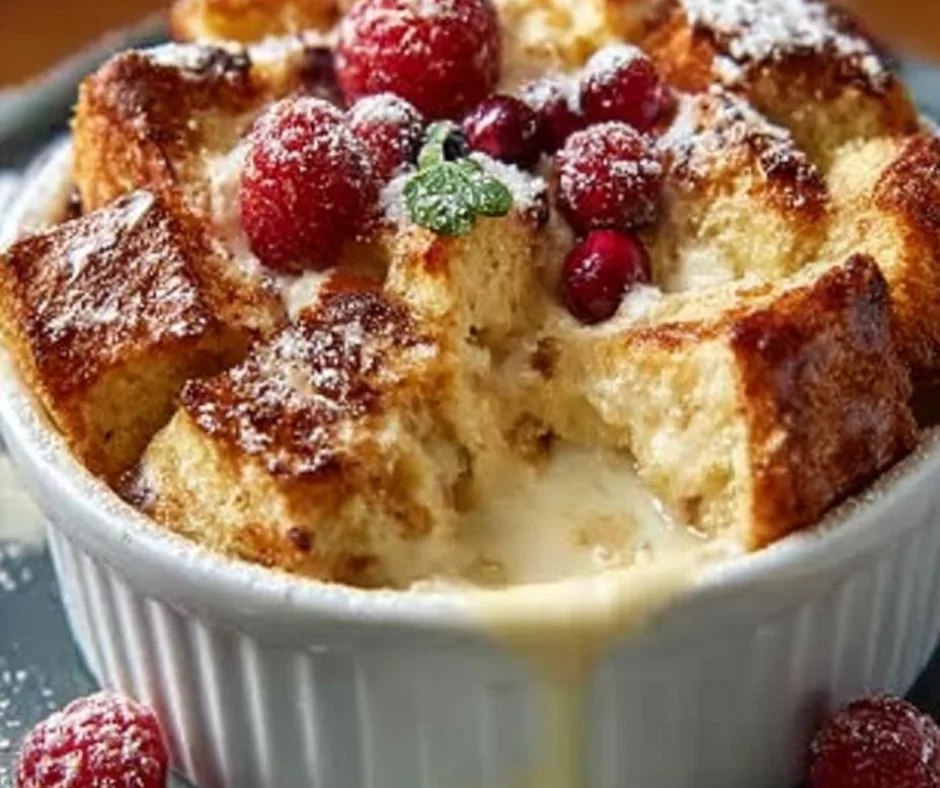
Decadent Eggnog Bread Pudding guide
Core Concepts: custard soak, bread selection (stale vs fresh), eggnog-to-egg ratio, spice balance (nutmeg, cinnamon), texture control (soak time + bake), topping choices (rum caramel, whipped cream), bake vs slow-cooker methods.
Basic Directions:
- Preheat your oven to 350°F (175°C). Grease a 9×13-inch baking dish.
- Cube the stale bread and place it in the greased baking dish.
- In a large bowl, whisk together the eggnog, eggs, sugar, and nutmeg until well combined.
- Pour the eggnog mixture over the cubed bread, ensuring all pieces are soaked thoroughly. Let it sit for about 10 minutes to absorb.
- Place the baking dish in the preheated oven and bake for 30-35 minutes, or until the top is golden brown and a toothpick inserted in the center comes out clean.
- Remove from the oven and let it cool for about 10 minutes before serving.
- Dish out warm portions and top with whipped cream if desired.
Hook-Driven Introduction (H1) 🍮✨
Decadent Eggnog Bread Pudding guide — you’ll absolutely love this cozy, foolproof dessert that turns simple stale bread into an irresistible holiday centerpiece. In under an hour (including a short soak), you can create a warm, custardy pudding studded with festive spices and finished with a cloud of whipped cream or a boozy caramel drizzle. What makes this recipe truly game-changing is how pantry-friendly it is: common ingredients, comforting flavors, and endless room for creativity. Ready to master a dessert that’s fast, family-approved, and perfect for any winter gathering? Keep reading — I’ll walk you through history, substitutions, pro tips, troubleshooting, and even slow-cooker and rum-caramel variations so you can make this recipe your own. 🎄🍽️
Attributes Origin & Cultural Context (H2) 🕯️
Bread pudding has roots in frugality: a practical way to rescue stale bread by turning it into something luxurious. The earliest recorded versions date back to medieval Europe when cooks combined bread with milk and eggs to make a simple, filling dish. Over time, the pudding evolved from peasant sustenance into an elegant dessert. In the United States and parts of the UK, bread pudding became a comfort-food staple — warm, spiced, and often drizzled with leftover custard or spirits.
My family’s version is steeped in holiday traditions. Growing up, my grandmother would reserve last week’s challah or brioche after Hanukkah dinner and turn it into a fragrant pudding using homemade eggnog. The aroma of nutmeg and cinnamon as it baked became a signal that the season had truly started. What makes this Decadent Eggnog Bread Pudding special is the use of eggnog itself — not just milk — which amps up the creaminess and adds the complex flavors of nutmeg, vanilla, and sometimes a hint of rum. Regional variations exist: some southern cooks add bourbon or a pecan topping, while New England versions lean into whole spices and clotted cream-style finishes.
SEO note: this is a Traditional Decadent Eggnog Bread Pudding guide and an Authentic Decadent Eggnog Bread Pudding origin story rolled into one.
Why This Decadent Eggnog Bread Pudding Guide is a Game-Changer (H2) ⚡💰👨👩👧👦
This guide simplifies how to understand Decadent Eggnog Bread Pudding so you can make it at home easily and confidently. Here’s why it stands out:
- Lightning Fast: From prep to table in about 60–70 minutes. The soak is short and the bake is predictable, so you can plan around holiday timelines or weeknight treats. Knowing exact timings removes guesswork.
- Budget-Friendly: Stale bread often destined for the trash becomes the star. The other ingredients (eggs, eggnog, sugar, spices) are pantry staples for many households, making this an economical dessert.
- Family Approved: The flavor profile is universally comforting — sweet custard, warm spices, soft bread — appealing to kids and adults alike. It’s an easy dish to scale up for potlucks or down for a cozy night in.
- Nutritiously Delicious: While undeniably indulgent, you can add nut-forward toppings (like toasted walnuts) or swap for lower-sugar eggnog to balance richness. The dish also supports mental well-being by triggering nostalgia and comfort during holiday stress.
- Infinitely Customizable: This guide teaches the core technique so you can adapt to dietary needs (dairy-free eggnog, gluten-free bread) or flavor twists (cranberry-orange, chocolate-chip).
- Pantry-Friendly: No exotic tools required. If you know how to whisk eggs and bake, you’re set.
This is the best Decadent Eggnog Bread Pudding guide for beginners and experienced bakers alike because it focuses on the why — the custard-to-bread ratio and the soak time — not just the what. That understanding makes it an easy Decadent Eggnog Bread Pudding learning experience and elevates your results every time.
Long-tail focus: How to understand Decadent Eggnog Bread Pudding at home easily; Quick Decadent Eggnog Bread Pudding guide.
Complete Concept Breakdown (H2) 📚
Essential concepts for Decadent Eggnog Bread Pudding:
- Custard Basics: The custard is the soul. Typical ratio: about 1 large egg per 1/2 to 3/4 cup liquid for a soft set. Eggnog substitutes milk/cream plus spices.
- Bread Choice: Dense breads like challah, brioche, sourdough (for contrast), or day-old sandwich bread work. Stale bread absorbs better without turning mushy.
- Soak Time: Short vs long: 10–30 minutes works for cubed bread; longer yields a uniformly custardy interior.
- Spice Balance: Nutmeg is classic; cinnamon, allspice, or cardamom can complement. Use fresh-grated nutmeg for the brightest flavor.
- Texture Control: More eggs = firmer pudding; more liquid = softer, custard-like center.
- Heat Management: Bake at 350°F for even cooking; a water bath is optional if you want extremely even texture.
Enhancers (examples, analogies):
- “Like a sponge” — bread absorbs custard similarly to how a sponge soaks water; denser bread soaks slower but holds more.
- Add-ins operate like mix-ins in muffin batter — distributed evenly for bites of contrast.
Optional add-ins:
- Dried fruit (raisin, currants, chopped dates)
- Chocolate chips
- Toasted nuts (pecans, walnuts)
- Citrus zest (orange is classic with eggnog)
- A splash of rum, bourbon, or brandy
Smart substitutions:
- Dairy-free: Use almond or oat-based eggnog and a flax-egg or commercial egg replacer for vegan versions.
- Gluten-free: Substitute GF bread and check eggnog ingredients.
- Lower sugar: Use less sugar and finish with a light dusting of confectioners’ sugar or a sugar-free syrup.
Where to learn: Practice the basic recipe twice; tweak custard ratios and bake times. For complex swaps (vegan or GF), test small batches first.
Pro tip: If your bread is very fresh, dry it in a low oven for 10–15 minutes to mimic “stale” texture.
Required Tools & Resources (H2) 🛠️
Essential:
- 9×13-inch baking dish (glass or metal)
- Mixing bowls (one large)
- Whisk and rubber spatula
- Measuring cups and spoons
- Oven thermometer (optional but helpful)
Nice-to-have:
- Kitchen scale (for precise custard ratios)
- Fine grater for nutmeg
- Silicone spatula for clean serving
- Slow cooker (for alternative slow-cooked method)
Budget alternatives:
- Use a metal roasting pan if you don’t have a 9×13; adjust bake time slightly.
- A fork and bowl can substitute for a whisk in small batches.
Specific recommendations:
- Glass baking dish (9×13) — holds heat well and gives an even crust.
- Microplane grater — Incredible for fresh nutmeg and citrus zest.
Foolproof Step-by-Step Learning Process (H2) 🧭
This section walks you through the process in clear steps with sensory cues and pro tips.
Step 1: Prep and Preheat (10 minutes)
- Action: Preheat oven to 350°F (175°C). Grease a 9×13-inch dish.
- Visual cue: Oven reaches temp; dish shines with a thin butter coating.
- Pro tip: Preheat the dish in the oven for a few minutes, then remove and grease — gives a head start on even baking.
- Common mistake: Skipping the greasing leads to sticking.
Step 2: Cube and Layer Bread (5–10 minutes)
- Action: Cube bread into 1-inch pieces and layer in dish.
- Sensory cue: Bread should feel slightly firm; if fresh, toast for 8–10 minutes at 300°F to dry.
- Pro tip: Tear some pieces into irregular shapes for variation in texture.
- Common mistake: Using too-small pieces (will mat) or too-large (will not soak evenly).
Step 3: Make the Custard (5 minutes)
- Action: Whisk eggnog, eggs, sugar, and nutmeg until smooth.
- Sensory cue: Mixture should be silky, with the aroma of nutmeg rising.
- Pro tip: Temper eggs by whisking eggnog into eggs slowly to avoid scrambling.
- Common mistake: Overbeating eggs can add unwanted air and alter texture.
Step 4: Combine and Soak (10–15 minutes)
- Action: Pour custard evenly over bread, pressing down gently to ensure absorption. Let sit 10–30 minutes depending on bread density.
- Visual cue: Custard disappears into bread; top looks moistened not soupy.
- Pro tip: Cover with plastic wrap and press lightly to encourage uniform soak.
- Common mistake: Baking immediately without soaking leads to dry pockets.
Step 5: Bake (30–40 minutes)
- Action: Bake at 350°F until puffed and golden; a toothpick should come out mostly clean with a few moist crumbs.
- Sensory cue: Smell of spices, edges browned.
- Pro tip: If the top browns too quickly, tent loosely with foil.
- Common mistake: Overbaking makes the pudding dry and crumbly.
Step 6: Rest and Finish (10 minutes)
- Action: Let cool for 10 minutes. Add toppings like whipped cream, caramel, or a splash of spirit.
- Visual cue: Slight settling; center should be set but soft.
- Pro tip: Serve warm for best texture; cold pudding is denser and can be revived with a quick 15–20 second microwave zap per serving.
- Common mistake: Cutting too soon breaks the set.
H3: Building the Base
- Mastering the custard ratio is the key; start with the basic directions above and adjust eggnog volume if you want a firmer (less liquid) or softer (more liquid) set.
H3: Application Techniques Explained
- For batch serving and potlucks, bake in individual ramekins for easier portioning and prettier presentation.
H3: Integration Methods
- Drizzle a warm rum-caramel sauce at serving time for an upscale finish, or fold in chocolate chips during the soak for melty pockets.
H3: Final Reflection
- After your first bake, take notes: how long you soaked, bread type, and final texture. These small records will guide perfect repeats.
Expert Insights & Strategies (H2) 🧠
From pastry chefs and experienced home bakers:
- Custard control: Use whole eggs for structure, add an extra yolk if you want silkier custard (yolks add richness).
- Temperature technique: Remove from the oven when the center still has a slight jiggle; it will set while resting.
- Spice layering: Toast whole nutmeg or cinnamon sticks, grate fresh for a stronger, fresher flavor.
- Alcohol timing: If adding spirits (rum, bourbon), fold into the custard or finish as a warmed sauce — alcohol added too early can affect set.
- Texture contrast: Toasted nuts or a streusel topping add crunchy contrast to the custard.
- Timing optimization: If serving for a crowd, bake 90 minutes ahead and reheat gently — or bake in individual dishes and reheat quickly.
- Troubleshooting fix: If the center is runny after baking, return to the oven covered with foil and bake 5–10 more minutes.
- Presentation trick: Use segmented toppings — a ring of caramel, a dollop of crème fraîche, and a sprinkle of grated nutmeg — for professional appeal.
Common failures and solutions:
- Dry pudding → reduce bake time or increase custard liquid.
- Soggy pudding → reduce soak time or use denser bread.
- Bland flavor → increase spices slightly and add a pinch of salt to the custard to enhance sweetness.
Creative Variations & Adaptations (H2) 🎨
Decadent Eggnog Bread Pudding variations:
Contextual variations:
- Slow-Cooker Style: Cook on low for 2–3 hours for a hands-off method (yields a creamier, more uniform texture).
- Individual Ramekins: Elegant plating and easy reheating.
Application modifications:
- Breakfast version: Add chopped apples and drizzle with maple syrup.
- Party version: Spike a portion with warmed rum caramel or serve with a rum-soaked raisin compote.
Cultural twists:
- Southern: Pecan streusel and bourbon glaze.
- Latin-inspired: Add dulce de leche and cinnamon-laced crema.
- European: Serve with brandy butter or clotted cream.
Practical transformations:
- Vegan: Use commercial vegan eggnog + firm tofu blended for custard body or a chickpea-flour egg replacer.
- Gluten-free: Use gluten-free brioche or sandwich bread.
Scalable versions:
- Multiply the recipe in hotel pans for large gatherings; use a convection oven for even baking.
- Mini-muffin tins for bite-sized portions — reduce bake time to 12–18 minutes.
Keywords: Decadent Eggnog Bread Pudding variations; Different ways to apply Decadent Eggnog Bread Pudding.
Breakdown & Benefits Analysis (H2) 📈
Per Application (makes X insights)
Home Dinner (serves 6–8)
- Impact: High — comfort factor and nostalgia
- Depth: 80% custard richness
- Relevance: 9/10
- Flexibility: 8/10
Brunch (serves 8–10)
- Impact: Medium — pairs well with coffee and mimosas
- Depth: 70% (lighter toppings)
- Relevance: 8/10
- Flexibility: 9/10
Benefits of key concepts:
- Custard ratio ensures consistent texture (less variability between bakes).
- Bread selection influences absorption and final crumb structure.
- Spice and alcohol choices control flavor intensity and perceived luxury.
Considerations:
- Dietary needs affect substitutions — note that texture and flavor will shift with dairy-free or egg-free swaps.
- Timing for serving: Serve warm for maximum sensory effect; reheating is possible but changes mouthfeel.
Adaptation-friendly modifications:
- For nut allergies, omit nuts and add toasted seeds (pumpkin or sunflower).
- For lower-sugar needs, use unsweetened eggnog and sweeten lightly at service.
Enhancement highlights:
- Freshly grated nutmeg and a light sprinkle of sea salt elevate the overall flavor.
- Serving with a light whipped mascarpone balances richness.
Motivational benefits:
- This recipe turns leftovers into celebration food — a compelling food-sustainability win that boosts kitchen creativity.
Storage, Application & Learning Prep (H2) 🧾
Proper retention methods (notes/memory):
- Keep a baking journal: note bread type, soak time, bake time, and any add-ins. This will make replication effortless.
- Photograph your first successful bake as a visual reference.
Best tools to use:
- Airtight container: Refrigerate leftovers for 3–4 days.
- Reheat method: Microwave individual portions for 20–30 seconds or reheat in a 325°F oven covered with foil for 10–15 minutes.
Application techniques for optimal use:
- For catering, bake in hotel pans and reheat in convection ovens for even warmth.
- For make-ahead: Assemble the night before, refrigerate covered, then bake the next morning (add 5–10 minutes to bake time).
Learning prep strategies:
- Start with the base recipe as your control. Make one variable change at a time (e.g., swap bread) to learn its effect.
- Use taste tests — small spoonfuls while cooling — to judge doneness and flavor balance.
How long knowledge lasts:
- Once you understand custard ratios and soak mechanics, the core technique lasts indefinitely — you’ll be able to adapt to many variations and dietary needs.
SEO phrase: How to retain Decadent Eggnog Bread Pudding knowledge.
Troubleshooting Common Issues (H2) 🛠️
Problem → Solution
Problem: Dry, crumbly pudding
- Solution: Reduce bake time by 5–10 minutes next time; increase custard volume slightly (add 1/4 cup eggnog or one extra yolk).
Problem: Soggy bottom or uncooked center
- Solution: Ensure adequate soak time but not oversaturation; bake longer covered with foil if edges are done but center is raw.
Problem: Bland flavor
- Solution: Add zest (orange) or a pinch of salt to the custard to enhance flavors. Consider a finishing sauce (rum caramel) for depth.
Problem: Top browns too quickly
- Solution: Tent with foil halfway through baking.
Problem: Custard curdles or eggs scramble during mix
- Solution: Temper eggs by slowly whisking warm eggnog into beaten eggs, or ensure eggnog is room temperature before mixing.
Problem: Too sweet for preference
- Solution: Reduce added sugar, pair servings with tangy whipped cream or mascarpone to balance sweetness.
Comprehensive FAQ Section (H2) ❓
Q1: Can I apply this Decadent Eggnog Bread Pudding guide universally?
A: Yes — the foundational technique (custard-to-bread soak and bake) works across breads, cultures, and dietary tweaks. Adjust ratios and bake times as you scale or substitute.
Q2: How far in advance can I prepare for Decadent Eggnog Bread Pudding?
A: You can assemble the dish and refrigerate it covered overnight, then bake the next day (add 5–10 minutes to the bake time). Fully baked pudding keeps 3–4 days refrigerated.
Q3: What’s the best way to integrate Decadent Eggnog Bread Pudding insights into holiday menus?
A: Use it as a make-ahead dessert or bake in individual ramekins for elegant plating. Pair with coffee or a digestif to finish a meal.
Q4: Can I adapt this Decadent Eggnog Bread Pudding guide for dietary needs?
A: Yes — dairy-free eggnog, gluten-free bread, or vegan replacements can work. Expect textural differences and test small batches first.
Q5: Is this Decadent Eggnog Bread Pudding guide beginner-friendly?
A: Absolutely. The steps are straightforward, and the recipe is forgiving. Follow the soak and bake cues and keep notes.
Q6: What’s the best topping for maximum flavor contrast?
A: A warm rum or bourbon caramel provides richness, while lemon or orange zest brightens flavors. Toasted nuts add crunch.
Q7: Can I freeze bread pudding?
A: Yes — freeze cooled, wrapped portions for up to 2 months. Thaw overnight in the fridge and reheat gently.
Q8: How can I make it less rich for daytime serving?
A: Reduce the eggnog or substitute part with milk, and lighten toppings (no caramel, use fresh fruit or a dollop of low-fat yogurt).
Related Guides & Applications (H2) 🔗
Complementary topics to explore:
- Classic Bread Pudding base recipes (without eggnog)
- Homemade Spiced Eggnog from scratch
- Rum caramel sauce recipes for dessert sauces
- Slow-cooker bread puddings for hands-off methods
Suggested learning path:
- Master the basic bread pudding (no special flavors).
- Make a batch with store-bought eggnog to experience the flavor shift.
- Try a slow-cooker version to compare textures.
- Experiment with toppings and spirits.
Resource pairings: Pair this guide with a caramel sauce tutorial and a quick eggnog-from-scratch post for full mastery.
Summary Card & Reference Version (H2) 🔖
Quick concept list:
- Core: Custard + bread + bake (1 egg ≈ 1/2–3/4 cup liquid)
- Bread: Day-old brioche, challah, or dense sandwich loaf
- Soak: 10–30 minutes depending on bread
- Bake: 350°F for 30–40 minutes; toothpick test
- Finish: Whipped cream, caramel, or toasted nuts
Learning time summary:
- Prep: 20 minutes
- Soak: 10–30 minutes
- Bake: 30–40 minutes
- Total: ~60–90 minutes (depending on soak and cooling)
Reference-friendly format:
- Note custard ratio adjustments and topping choices in your kitchen journal. Use this card as a quick checklist before you start baking.
Conclusion (H2) 🎉
You’ve now got a complete Decadent Eggnog Bread Pudding guide — from cultural history and essential concepts to hands-on steps, troubleshooting, and creative variations. Whether you stick with the classic oven-baked method or try a slow-cooker twist, the key is understanding the custard-to-bread relationship and adjusting based on texture and flavor goals. Try the slow-cooker style if you prefer a hands-off, custardy finish, or explore a boozy rum-caramel as an indulgent topping for special occasions.
For further inspiration and step-by-step alternative methods, check out this Slow Cooker Eggnog Bread Pudding • FIVEheartHOME and a festive rum-caramel version at Eggnog Bread Pudding with Rum Caramel Sauce – Casual Foodist.
If you loved this guide, please leave a comment, tag your creations on social, and save this page for your next holiday bake. Happy baking and may your kitchen be warm and fragrant with nutmeg! 🍽️🎄
Slow Cooker Eggnog Bread Pudding • FIVEheartHOME
Eggnog Bread Pudding with Rum Caramel Sauce – Casual Foodist
Print
Decadent Eggnog Bread Pudding
- Total Time: 55 minutes
- Yield: 8 servings 1x
- Diet: Vegetarian
Description
A cozy and indulgent dessert that transforms stale bread into a custardy treat infused with festive spices and topped with whipped cream or rum caramel.
Ingredients
- 8 cups stale bread, cubed (challah, brioche, or dense sandwich bread)
- 2 cups eggnog
- 4 large eggs
- 1/2 cup sugar
- 1/2 teaspoon nutmeg (freshly grated preferred)
- Optional toppings: whipped cream, rum caramel, toasted nuts
Instructions
- Preheat your oven to 350°F (175°C). Grease a 9×13-inch baking dish.
- Cube the stale bread and place it in the greased baking dish.
- In a large bowl, whisk together the eggnog, eggs, sugar, and nutmeg until well combined.
- Pour the eggnog mixture over the cubed bread, ensuring all pieces are soaked thoroughly. Let it sit for about 10 minutes to absorb.
- Place the baking dish in the preheated oven and bake for 30-35 minutes, or until the top is golden brown and a toothpick inserted in the center comes out clean.
- Remove from the oven and let it cool for about 10 minutes before serving. Dish out warm portions and top with whipped cream if desired.
Notes
For added richness, consider using an extra egg yolk in the custard mixture. Customize with optional add-ins like chocolate chips or dried fruit.
- Prep Time: 20 minutes
- Cook Time: 35 minutes
- Category: Dessert
- Method: Baking
- Cuisine: American
Nutrition
- Serving Size: 1 serving
- Calories: 350
- Sugar: 20g
- Sodium: 400mg
- Fat: 10g
- Saturated Fat: 5g
- Unsaturated Fat: 5g
- Trans Fat: 0g
- Carbohydrates: 49g
- Fiber: 2g
- Protein: 8g
- Cholesterol: 100mg