
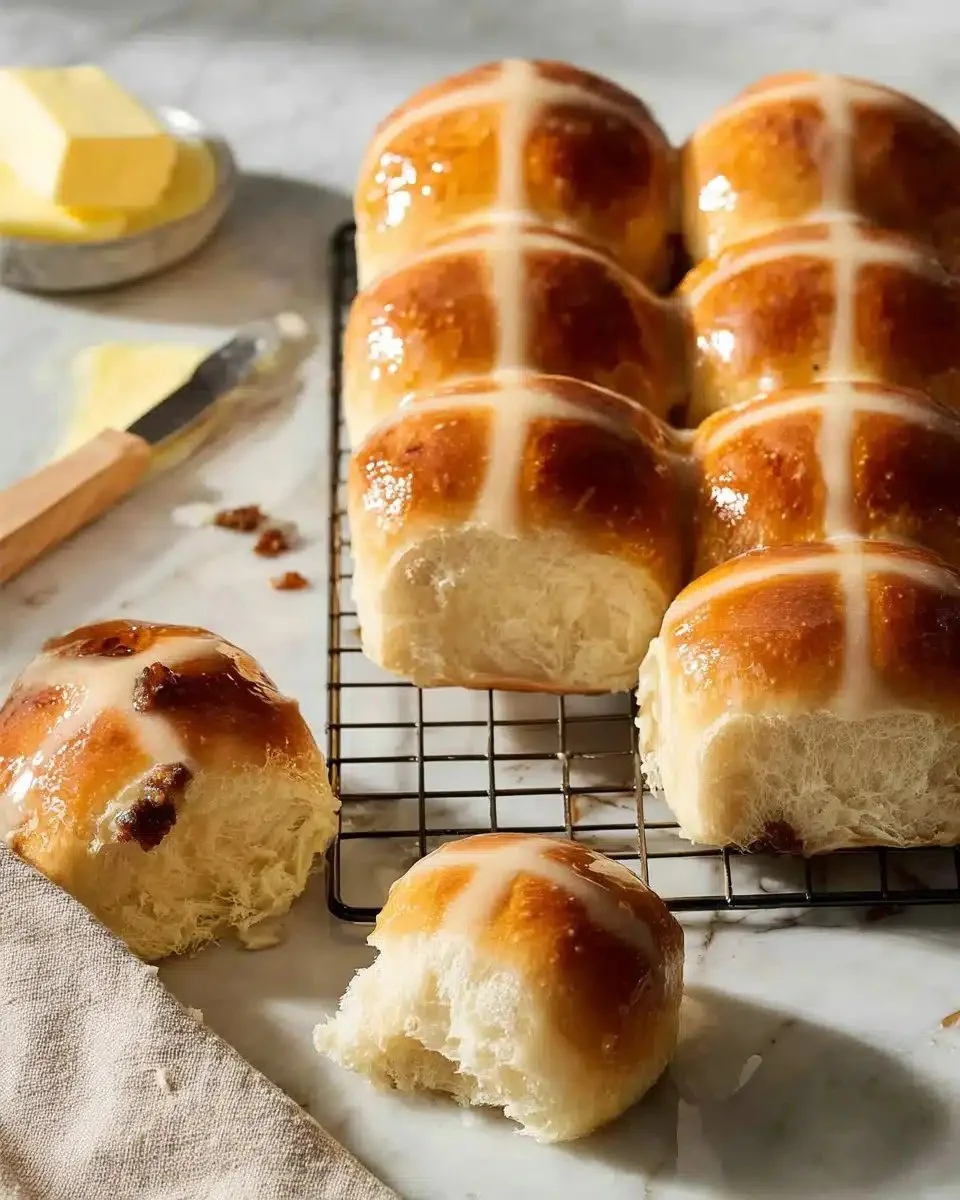
Classic Hot Cross Buns — Soft Spiced Yeast Buns
Warm, fragrant buns with a tender crumb and a sticky, spiced finish — Classic Hot Cross Buns are the kind of baked good that fills the kitchen with nostalgia. After testing this recipe 8 times across different flours and yeast brands, I landed on a formula that gives a reliably soft interior, even crumb, and deep spice flavor without overwhelming the dough. These are enriched yeast buns (with milk and butter) lightly sweetened and dotted with currants and orange zest. The cross is a simple flour paste that bakes pale; a sugar glaze afterward gives the shine.
This method is rooted in traditional British technique and adapted for home ovens. Expect two rises and about 30 minutes of active work. If you want something chocolatey alongside them, try pairing with our gooey hot cocoa recipe. Read on for exact measurements, precise timings, and pro tips to avoid dense buns and overproofing.
Why This Recipe Works
- Slow first rise develops flavor without needing a long fridge fermentation. The dough gains subtle acidity that balances the sweetness.
- Enrichment with butter and milk keeps the crumb soft and tender even after cooling.
- A small amount of diastatic malt powder (or honey) feeds the yeast for a consistent rise.
- The flour paste used for the cross bakes pale; glazing after baking gives the classic sheen without browning the cross.
- Gentle handling preserves the gas in the dough; shaping into tight buns yields an even crumb and neat domes.
These spice-forward buns pair nicely with warm, cinnamon-forward drinks for an indulgent breakfast.
Ingredients Breakdown
- All-purpose flour 500 g (4 cups): Provides structure. You can use 00 flour if you prefer a slightly silkier crumb. If using high-protein bread flour, the buns will be chewier.
- Granulated sugar 75 g (6 tbsp): Sweetens and helps browning. Reduce by 15–25 g for less-sweet buns.
- Salt 9 g (1 1/2 tsp Diamond Crystal or 1 tsp table salt): Enhances flavor. If using Morton’s kosher salt, use 3/4 tsp.
- Instant yeast 7 g (1 packet / 2 1/4 tsp): Use instant or active dry (if active dry, proof in warm liquid first).
- Whole milk 240 ml (1 cup), warmed to 38–43°C (100–110°F): Hydrates and adds richness. Too-hot milk will kill yeast.
- Unsalted butter 55 g (4 tbsp), softened: Adds tenderness and flavor. Melted butter will make the dough looser; use softened.
- Large egg 1 (50 g): Adds richness and improves rise. For an egg-free version, see Variations.
- Currants or raisins 120 g (3/4 cup): Traditional in hot cross buns. You can swap 100 g chopped mixed peel for extra citrus punch.
- Orange zest 1 tbsp (from 1 medium orange): Brightens flavor. Lemon zest can substitute.
- Ground cinnamon 1 tsp; ground nutmeg 1/4 tsp; ground allspice 1/4 tsp: Classic warm spices. Freshly ground spices taste best.
- Diastatic malt powder or honey 1 tsp: Optional; helps yeast activity and browning.
- For the cross paste: Plain flour 60 g (1/2 cup) + water 60–75 ml (1/4–1/3 cup) to form a pipeable paste.
- For the glaze: Apricot jam 2 tbsp + 1 tsp water, warmed and strained; or 60 g (1/4 cup) caster sugar + 60 ml (1/4 cup) water boiled to a syrup.
Substitutions with impact warnings:
- Whole milk → plant milk: Use unsweetened soy or oat for similar richness; texture may be slightly looser.
- Butter → coconut oil: The flavor and melting behavior change; buns will be less rich-tasting.
- Currants → chocolate chips: Will change the classic flavor. Use 100 g and reduce added sugar by 15 g.
If you’re exploring enriched doughs, this recipe shares many shaping and handling techniques with soft pretzel doughs.
Essential Equipment
- Stand mixer with dough hook (recommended) or a large bowl and a strong arm for hand-kneading.
- Digital scale — weigh flour for consistency. Volume measures are given, but weight is more precise.
- Thermometer to check milk and dough temperature.
- Baking sheet or half-sheet pan and parchment paper. Use a rimmed sheet to catch any overflow during the second rise.
- Piping bag or small zip-top bag with corner snipped for crossing paste. If you don’t have a piping bag, use a teaspoon to spoon lines, then thinly spread with a wet finger.
- Small saucepan and pastry brush for glaze. No saucepan? Microwave the jam briefly until spreadable.
Step-by-Step Instructions
Makes 12 buns | Prep time 30 minutes | Cook time 20 minutes | Inactive time 2 hours | Total time ~3 hours | Serves 12 (1 bun each)
Step 1: Warm the milk and proof (if using active dry yeast)
Warm 240 ml (1 cup) whole milk to 38–43°C (100–110°F). Stir in 1 tsp honey or diastatic malt and sprinkle 7 g (1 packet) instant yeast. If using active dry yeast, let it sit 5–8 minutes until foamy; if using instant yeast, add directly to flour in the next step. This confirms the yeast is alive; note the foam cue.
Step 2: Mix dry ingredients
In the mixer bowl combine 500 g (4 cups) all-purpose flour, 75 g (6 tbsp) granulated sugar, 9 g (1 1/2 tsp Diamond Crystal or 1 tsp table salt), 1 tsp ground cinnamon, 1/4 tsp ground nutmeg, and 1/4 tsp ground allspice. Whisk to distribute spices evenly. This ensures even flavor distribution.
Step 3: Combine and knead
Add the warmed milk mixture, 1 large egg (50 g), and 55 g (4 tbsp) softened unsalted butter to the dry mix. Mix on low with a dough hook until a shaggy dough forms, about 2 minutes, then increase to medium and knead 6–8 minutes until the dough is smooth and elastic. Do not overmix — stop when the dough passes a light windowpane test or is slightly tacky.
Step 4: Add fruit and rest
Fold in 120 g (3/4 cup) currants and 1 tbsp orange zest for 1 minute on low so the fruit distributes without shredding. Transfer to a lightly oiled bowl, cover, and let rise in a warm spot until doubled, about 60–75 minutes depending on room temperature (proof until a gentle poke springs back slowly).
Step 5: Shape the buns
Turn the dough onto a lightly floured surface and divide into 12 even pieces, about 60–65 g each. Pre-shape into rounds, rest 10 minutes, then roll into tight buns and place on a parchment-lined baking sheet 3–4 cm (1–1½ in) apart. Tight shaping gives a neat dome.
Step 6: Second rise
Cover the shaped buns with lightly greased plastic or a tea towel and proof again until puffy and nearly doubled, 45–60 minutes; the buns should slowly return when pressed. Do not overproof — if the dough deflates when you press, it was overproofed.
Step 7: Pipe the crosses and bake
Mix 60 g (1/2 cup) plain flour with 60–75 ml (1/4–1/3 cup) water to a pipeable paste. Transfer to a piping bag and pipe crosses across each bun. Bake in a preheated oven at 200°C (400°F) for 12–15 minutes until the tops are golden and the internal temp reaches about 90°C (194°F). Rotate the pan at 8 minutes if your oven has hot spots.
Step 8: Glaze and finish
Warm 2 tbsp apricot jam with 1 tsp water and brush over hot buns as soon as they come from the oven. This gives shine and a slight stickiness. Cool on a rack for at least 20 minutes before serving to set the crumb.
Expert Tips & Pro Techniques
- Always weigh flour. Small differences in cup packing change hydration and can make dense buns.
- Common mistake: Overproofing. If buns collapse in the oven, your dough was overproofed. Proof until just puffy and springy.
- Use a thermometer. Dough temperature around 24–26°C (75–78°F) after kneading gives reliable fermentation.
- Make-ahead: After shaping, freeze the tray of unbaked buns on a sheet pan for 1–2 hours, then transfer to bags. Bake from frozen, adding 5–7 minutes to the bake time, still piping the crosses before baking.
- Professional trick adapted for home ovens: Use steam. Place a small metal pan with hot water on the bottom rack during the first 5 minutes of bake to help oven spring and shine. Remove after 5 minutes to allow browning.
- If you prefer a pale cross, pipe with thicker paste (less water). If the cross browned too quickly, reduce oven temperature by 10–15°C (50–60°F) and extend bake time slightly.
Shaping and proofing steps here are similar to other enriched roll recipes, so those techniques will transfer if you bake rolls often.
Storage & Reheating
- Refrigerator: Store cooled buns in an airtight container for up to 3 days. Refrigeration can dry them; bring to room temp before reheating.
- Freezer: Freeze cooled buns wrapped individually in plastic, then in a freezer bag for up to 3 months. To bake from frozen, place on a sheet and add 5–7 minutes to the bake time. To thaw, leave at room temperature for 1–2 hours.
- Reheating: Reheat in a 175°C (350°F) oven for 7–10 minutes until warmed through. Avoid microwaving whole buns — it makes them gummy or tough.
Variations & Substitutions
- Gluten-Free Version: Replace 500 g all-purpose flour with a 1:1 GF blend (Bob’s Red Mill-style), add 1 tsp xanthan gum, and expect slightly longer mixing and a denser crumb; bake for 15–18 minutes.
- Egg-Free Version: Replace the egg with 50 g (1/4 cup) unsweetened applesauce plus 10 g (1 tbsp) extra butter; texture will be slightly less rich but still tender.
- Chocolate Buns: Replace currants with 120 g (3/4 cup) dark chocolate chips and add 1 tsp vanilla. Keep sugar the same. Baking time is unchanged.
- Overnight Slow Rise: Mix dough, chill covered in the fridge for 8–12 hours for a deeper flavor. Bring to room temp, shape, and proof for 60–90 minutes before baking; inactive time increases.
- Reduced-Sugar Version: Reduce sugar to 50 g (4 tbsp); overnight proofing helps maintain flavor when sugar is reduced.
Serving Suggestions & Pairings
- Classic: Serve warm with softened butter and a pot of strong black tea.
- Brunch spread: Pair with scrambled eggs and smoked salmon for contrast.
- For chocolate lovers: Serve with our hot cocoa balls with marshmallows and peanut butter for a decadent pairing.
- Lightly toasted with clotted cream and orange marmalade makes a rich afternoon treat.
Nutrition Information
Serving size: 1 bun | Makes 12 servings
Estimated per serving:
- Calories: 260 kcal
- Total Fat: 7.5 g
- Saturated Fat: 4.0 g
- Cholesterol: 35 mg
- Sodium: 210 mg
- Total Carbohydrates: 42 g
- Dietary Fiber: 1.5 g
- Sugars: 10 g
- Protein: 5.5 g
Nutrition values are estimates. Actual values may vary based on specific ingredients and preparation methods.
Frequently Asked Questions
Q: Why did my hot cross buns turn out dense?
A: Dense buns usually mean under-kneading, too little rise time, or too much flour. Weigh flour, knead until elastic, and proof until the dough is visibly puffy and springs back slowly when pressed.
Q: Can I make these without eggs?
A: Yes. Replace 1 large egg with 50 g (1/4 cup) unsweetened applesauce and add 10 g (1 tbsp) extra butter. The texture will be slightly less rich but still tender.
Q: Can I double this recipe?
A: Yes. Double all ingredients and use two mixing bowls or a larger mixer batch. Divide dough into two equal portions for the first rise. Use two sheet pans for baking to avoid overcrowding.
Q: Can I prepare this the night before?
A: Yes. After mixing and first rise, shape the buns, place on a tray covered, and refrigerate overnight. In the morning, proof 45–60 minutes at room temp and bake. This deepens flavor.
Q: How long do hot cross buns keep in the fridge?
A: Store in an airtight container for up to 3 days. For longer storage, freeze individually for up to 3 months.
Q: Can I add other dried fruit or nuts?
A: Yes. Swap currants for 120 g (3/4 cup) chopped dried apricots, cherries, or 75 g chopped walnuts. Nuts may toast faster; watch bake time.
Q: What oven temperature and time should I use for a darker top?
A: Increase oven to 210°C (410°F) and bake 12–14 minutes, checking closely to avoid burning the cross. Alternatively, finish with a light broil for 20–30 seconds but watch steadily.
Conclusion
These Classic Hot Cross Buns yield a soft, spiced, and slightly sticky bun that holds up well for brunch or a celebratory breakfast. For additional classic techniques and an alternate Hot Cross Buns take, see Classic Hot Cross Buns – Cloudy Kitchen. For another well-tested home bakers’ version and background on variations, check Classic Hot Cross Buns Recipe – Maureen Abood.
Enjoy baking — and don’t be afraid to adjust the spice levels and fruit to match your taste.
Print
Classic Hot Cross Buns
- Total Time: 120 minutes
- Yield: 12 servings 1x
- Diet: Vegetarian
Description
Warm, fragrant buns with a tender crumb, spiced finish, and a shiny glaze — Classic Hot Cross Buns are perfect for breakfast or brunch.
Ingredients
- 500 g (4 cups) all-purpose flour
- 75 g (6 tbsp) granulated sugar
- 9 g (1 1/2 tsp) salt
- 7 g (1 packet / 2 1/4 tsp) instant yeast
- 240 ml (1 cup) whole milk, warmed
- 55 g (4 tbsp) unsalted butter, softened
- 1 large egg (50 g)
- 120 g (3/4 cup) currants or raisins
- 1 tbsp orange zest
- 1 tsp ground cinnamon
- 1/4 tsp ground nutmeg
- 1/4 tsp ground allspice
- 1 tsp diastatic malt powder or honey (optional)
- 60 g (1/2 cup) plain flour (for cross)
- 60–75 ml (1/4–1/3 cup) water (for cross)
- 2 tbsp apricot jam and 1 tsp water (for glaze)
Instructions
- Warm the milk and proof the yeast.
- Mix dry ingredients in a bowl.
- Combine the milk mixture with other ingredients and knead.
- Fold in currants and zest, then let rise.
- Shape dough into buns and let them rise again.
- Pipe crosses on buns and bake at 200°C (400°F).
- Glaze the buns with apricot jam after baking.
Notes
Store cooled buns in an airtight container for up to 3 days or freeze for up to 3 months.
- Prep Time: 30 minutes
- Cook Time: 15 minutes
- Category: Breakfast
- Method: Baking
- Cuisine: British
Nutrition
- Serving Size: 1 bun
- Calories: 260
- Sugar: 10g
- Sodium: 210mg
- Fat: 7.5g
- Saturated Fat: 4g
- Unsaturated Fat: 3.5g
- Trans Fat: 0g
- Carbohydrates: 42g
- Fiber: 1.5g
- Protein: 5.5g
- Cholesterol: 35mg