
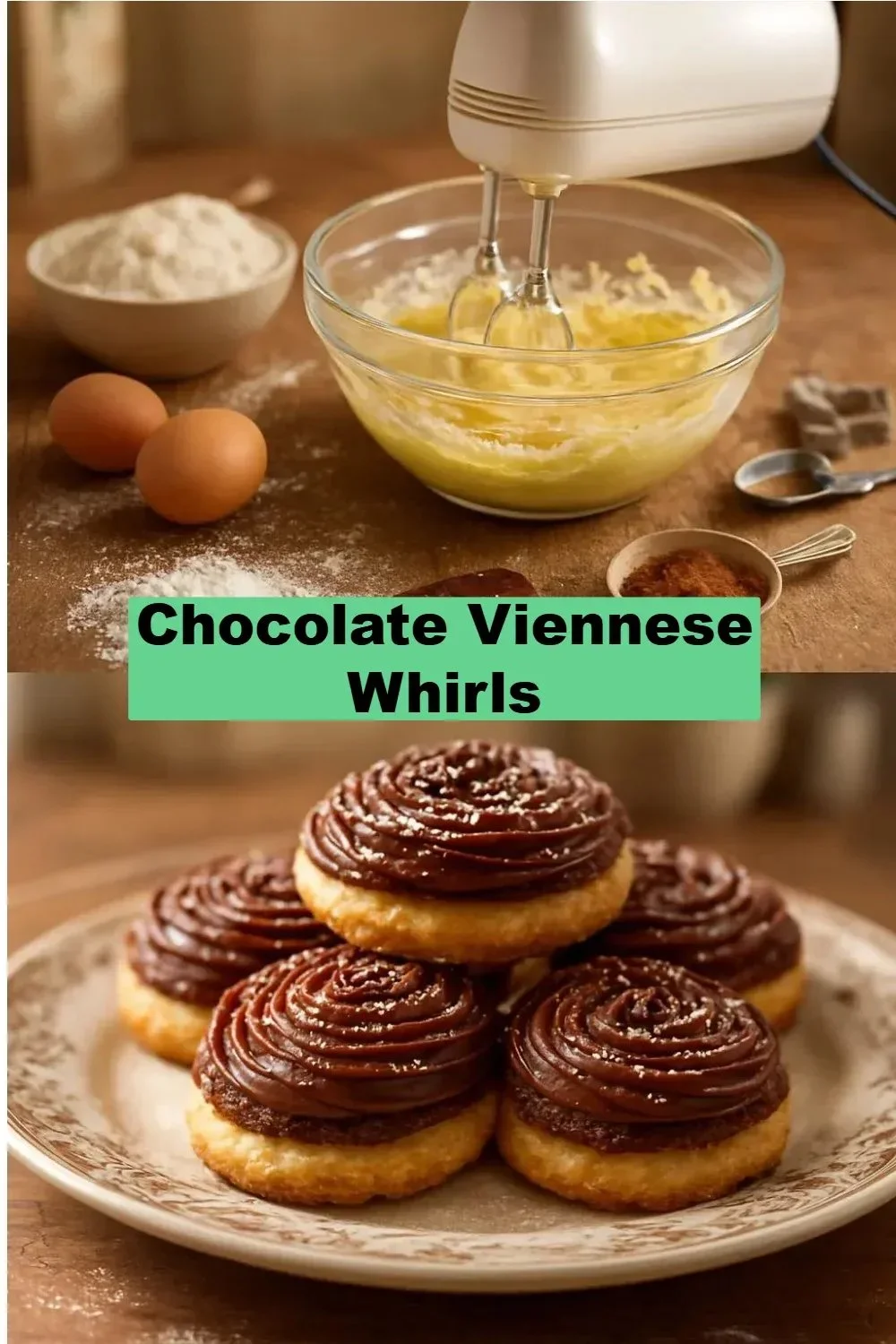
Chocolate Viennese Whirls guide — your foolproof recipe and masterclass 🍫✨
Ready for the most irresistible Chocolate Viennese Whirls guide that takes just a little patience and a lot of joy to master? You’ll absolutely love how quick, elegant, and crowd‑pleasing these chocolate piped biscuits are — they’re perfect for afternoon tea, holiday platters, or a cozy bake-along with friends. In this guide you’ll get a clear, step-by-step Chocolate Viennese Whirls guide that’s easy to follow, family‑friendly, and packed with pro tips to ensure consistent results every time. Expect game-changing timing cues, sensory checks, and simple substitutions so you can bake these with whatever’s in your pantry. By the end you’ll know how to understand Chocolate Viennese Whirls like a pro, from dough texture to perfect ganache sandwiches. Let’s pipe, chill, and bake our way to bliss. 🍪❤️
Title: Chocolate Viennese Whirls
Core Concepts: piped sablé-style butter dough; chilling to hold shape; cocoa for flavor and structure; large-star piping for classic whirls; ganache sandwich filling; gentle bake for tender centers; sugar balance for meltaway texture; simple substitutions (plant milk, alternative fats), temperature control.
Basic Directions:
- Preheat your oven to 190°C (375°F) and line baking sheets with parchment paper.
- In a mixing bowl, cream the softened butter and icing sugar together until light and fluffy.
- Sift in the plain flour, cornflour, cocoa powder, and mix until just combined. Adjust with plant milk if the dough is too dry.
- Transfer the dough into a piping bag fitted with a large star nozzle and pipe swirls onto the prepared baking sheets.
- Chill the piped dough in the refrigerator for 15 minutes.
- Bake in the preheated oven for 15-18 minutes, or until firm but still slightly soft in the center.
- Allow the biscuits to cool for 5 minutes on the trays before transferring to a wire rack to cool completely.
- To make the ganache, heat the double cream until just simmering, pour it over the chopped dark chocolate in a bowl, and let it sit for a few minutes before stirring until smooth.
- Allow the ganache to cool and thicken slightly.
- Pipe or spread ganache onto the underside of half of the biscuits and sandwich with the other halves.
- Optionally, dust with icing sugar before serving.
Attributes Origin & Cultural Context (H2) 🍰📜
Chocolate Viennese Whirls have their roots in classic European biscuit-making. The Viennese whirl family traces back to Austrian and Central European pastry techniques where piped, buttery cookies and biscuits were prized for their delicate texture and decorative swirl. Over time, British patissiers adopted and adapted the format into what we now enjoy as the Viennese whirl — often sandwiching two piped cookies with buttercream or jam. The chocolate variation adds cocoa for a richer profile and pairs beautifully with dark ganache.
Personal story: My grandmother kept a battered piping bag in the back of her cupboard; on rainy afternoons she’d hand me a star nozzle and teach me how to swirl, telling me that the secret was a steady wrist and the right chill time. That memory shaped this guide — it’s built to be approachable, patient, and just a little celebratory.
What makes this version special: this Chocolate Viennese Whirls guide emphasizes texture (melt‑in‑the‑mouth centers and crisp edges), consistent piping, and a silky ganache sandwich. Regional variations include jam-filled Viennese whirls in the UK, or chocolate-dusted versions in cafés across Vienna. This guide blends those traditions into a clear, reproducible method for home bakers.
Keywords: Traditional Chocolate Viennese Whirls guide • Authentic Chocolate Viennese Whirls origin • Classic Chocolate Viennese Whirls history
Why This Chocolate Viennese Whirls Guide is a Game-Changer (H2) ⚡🍪
This Chocolate Viennese Whirls guide is built to be fast, forgiving, and flexible. Here’s why it stands out — and how it helps you succeed every bake.
Lightning Fast: You can grasp the core technique in under 30 minutes — from creaming to piping basics — and have a batch chilling in the fridge. The learning curve is short; the results are immediate. If you want quick Chocolate Viennese Whirls learning, this guide gets you there.
Budget-Friendly: The ingredients are pantry staples — butter, flour, cocoa, sugar, and chocolate — and most steps require only basic tools. For budget alternatives, I suggest using light-tasting vegetable fats carefully (see substitutions below) or single-origin cocoa swaps that are cost-effective.
Family Approved: The method is accessible for young bakers (with supervision for oven and hot ganache). Kids enjoy piping the swirls and sandwiching the cookies. This makes the cookies great for family baking sessions.
Nutritiously Delicious: While these are treats, the cocoa and dark chocolate ganache can deliver antioxidants and a mood boost (pleasant aromas and the reward of baking reduce stress in small, proven ways). Baking itself is therapeutic — a small psychological lift many home bakers report.
Infinitely Customizable: Swap the ganache for buttercream, jam, or lemon curd. Replace cocoa with espresso powder for mocha notes. This guide explains adaptations so you can personalize without losing the texture.
Pantry-Friendly: The recipe leans on common ingredients and small batch techniques, so you can bake with what you already have.
Long-tail phrases included here: How to understand Chocolate Viennese Whirls at home easily • Best Chocolate Viennese Whirls guide for beginners • Quick Chocolate Viennese Whirls learning method • Expert-level Chocolate Viennese Whirls at home
Complete Concept Breakdown (H2) 🔍
Essential concepts for Chocolate Viennese Whirls are straightforward but each impacts the final biscuit. Understanding them helps you adapt and troubleshoot.
Main concepts list:
- Fat ratio and creaming: butter and sugar aeration influences texture.
- Flour and cornflour: cornflour (cornstarch) softens the crumb.
- Cocoa powder: flavor and a touch of dryness — balance carefully.
- Piping shape: large star nozzle creates the classic look and crisp edges.
- Chilling: sets the shape so the whirls keep their definition.
- Bake time/temp: short bake at moderate heat gives tender centers.
- Ganache consistency: slightly thickened so sandwiches don’t slip.
Detailed explanations for key concepts:
- Butter temperature: Soft but cool butter creams aeration into the dough. If butter is too warm, the dough spreads and loses the whirls. Pro tip: Cold butter results in a dense dough; room-soft is ideal.
- Cornflour role: A small percentage of cornflour reduces gluten strength, giving meltaway texture. Swap too much and you’ll lose structure; too little makes a cakier biscuit.
- Piping pressure: Even pressure produces uniform whirls. Practice on parchment to learn the feel.
Smart substitutions table (descriptive):
- Butter → Plant-based butter (1:1) for dairy-free, but check for higher water content; chill extra. 🥛→🌱
- Double cream → Coconut cream for dairy-free ganache; expect slightly different set.
- Plain flour → 00 or pastry flour for a softer bite.
- Icing sugar → Confectioners’ sugar (same) or blend granulated to finer texture if needed.
Learning and application tips:
- Practice piping shapes before filling trays.
- Keep a digital timer for chilling and baking — consistency is key.
- Note oven hot spots and rotate trays halfway through baking.
SEO phrases woven in: "Essential concepts for Chocolate Viennese Whirls", "Best examples for Chocolate Viennese Whirls", "Chocolate Viennese Whirls concept substitutions", "Where to learn piping technique"
Required Tools & Resources (H2) 🧰🍴
Essential tools:
- Stand mixer or hand mixer (for creaming butter and sugar)
- Mixing bowls (medium and small)
- Large star piping nozzle and disposable/reusable piping bag
- Baking trays and parchment paper
- Wire cooling rack
- Small saucepan and heatproof bowl for ganache
Nice-to-have resources:
- Digital kitchen scale (precision matters)
- Oven thermometer (many ovens run hot or cold)
- Silicone baking mats for consistent bottoms
- Bench scraper for dough handling
Budget alternatives:
- Hand whisk and elbow grease for creaming if no mixer.
- Zip-top bag with corner snipped as piping bag if you don’t own one.
- Microwave-safe bowl for ganache in place of stovetop double-boiler.
Specific recommendations:
- Use a 1M or large French star nozzle for classic swirls.
- A 500g–1kg digital scale reduces measuring errors that cause textural issues.
- Choose a dark chocolate around 60–70% for balanced ganache.
Foolproof Step-by-Step Learning Process (H2) 🧭 (500–600 words)
This section gives a repeatable, sensory-driven process. Each step includes timing, cues, pro tips, and common mistakes to avoid.
Step 1: Prepare and measure (10 minutes)
- Action: Preheat oven to 190°C (375°F) and line trays. Weigh butter, sugars, flour, cornflour, and cocoa.
- Visual cue: Butter should hold an indent but not look greasy or glossy.
- Pro tip: Use a scale — grams give consistent results.
- Common mistake: Eyeballing flour leads to dense biscuits.
Step 2: Cream butter and icing sugar (5–8 minutes)
- Action: Beat softened butter with icing sugar until pale and fluffy.
- Sensory cue: Mixture should be lighter in color and smooth.
- Pro tip: Scrape bowl sides every minute for even aeration.
- Mistake: Overbeating can cause butter to turn too soft; underbeat and the cookies won’t rise slightly.
Step 3: Fold in dry ingredients (3–5 minutes)
- Action: Sift plain flour, cornflour, and cocoa into the butter mix and combine until just cohesive. Add a teaspoon of plant milk only if the dough lacks body.
- Cue: Dough should form a soft mass that holds a piped shape.
- Pro tip: Don’t overmix — stop once streaks disappear.
- Mistake: Adding too much liquid to “rescue” a dry dough; instead add very small amounts.
Step 4: Pipe swirls (10–15 minutes) — H3 Building the Base
- Action: Fit a piping bag with a large star nozzle. Fill and practice piping a few swirls on scrap paper. Pipe onto trays about 4 cm apart.
- Visual cue: Swirls should have defined edges and a peaked center.
- Pro tip: Hold the bag perpendicular to the tray and apply steady pressure, lifting to finish peaks.
- Mistake: Moving the bag while piping; practice steady wrist motion.
Step 5: Chill piped dough (15 minutes)
- Action: Refrigerate trays to firm dough.
- Cue: Dough should feel cool to the touch and hold shape.
- Pro tip: Freeze 2–3 minutes extra if your kitchen is very warm.
- Mistake: Skipping chilling — swirls will spread.
Step 6: Bake (15–18 minutes) — H3 Application Techniques Explained
- Action: Bake on center rack. Rotate trays mid-bake for even color. Remove when edges are set and centers slightly soft.
- Cue: Slight springback when lightly pressed.
- Pro tip: Use an oven thermometer to ensure accurate temperature.
- Mistake: Overbaking until brown — that dries biscuits.
Step 7: Cool briefly on tray, then transfer (5–10 minutes)
- Action: Let cool 5 minutes on tray, then gently use a spatula to place on wire rack.
- Cue: Biscuits firm as they cool but remain tender inside.
- Pro tip: If bottoms are wet, bake an extra minute; if too brown, reduce temp next time.
Step 8: Make ganache (10 minutes + cooling) — H3 Integration Methods
- Action: Heat cream until just simmering, pour over chopped dark chocolate, let sit 3–5 minutes, stir until glossy. Cool until pipeable.
- Cue: Ganache coats the back of a spoon.
- Pro tip: Stir in a tiny pinch of salt to deepen flavor.
- Mistake: Using boiling cream — it can seize chocolate.
Step 9: Sandwich and finish (10–15 minutes)
- Action: Pipe a small mound of ganache on half the biscuits and top with matching halves. Dust with icing sugar if desired.
- Cue: Biscuits should stay together without slippage.
- Pro tip: Chill sandwiches briefly to set ganache if your kitchen is warm.
- Mistake: Overfilling — it squeezes out and makes presentation messy.
Step 10: Final Reflection (5 minutes) — H3 Final Reflection
- Action: Taste and note what you’d change (bake time, ganache thickness, piping consistency). Record adjustments.
- Pro tip: Keep a small baking journal — noting oven temp and tray placement will speed learning.
Practice loop: Repeat with small adjustments (bake 1–2 minutes less or more) until you consistently reach personal target texture.
Expert Insights & Strategies (H2) 🧑🍳✨
Here are advanced tips drawn from pastry technique principles and pro bakers’ habits.
- Butter temperature mastery: Aim for 16–18°C (60–64°F) — softer than fridge but not greasy.
- Use a bit of cornflour for that classic meltaway texture — 10–15% of total flour weight.
- Piping rhythm: Keep wrist steady, pause slightly at swirl peaks to finish neatly.
- Ganache set control: For sandwiching, let ganache cool until syrupy; too liquid will leak.
- Bake in the middle rack and avoid overcrowding trays for even airflow.
- Flavor layering: Add 1/4 tsp espresso powder to intensify chocolate without a coffee flavor.
- Timing optimization: Cool biscuits on wire rack to avoid steam softening the bottoms.
- Presentation trick: Pipe ganache slightly off-center for a rustic, handmade look.
Common failures and solutions:
- Spreading whirls → chill dough and lower oven temp by 10°C.
- Dry centers → reduce bake time by 1–2 minutes and check oven accuracy.
- Ganache too soft → increase chocolate ratio or chill slightly.
Professional-style tricks:
- Make extra ganache and keep chilled for 48 hours — it firms slightly and tastes better after rest.
- For gifting, stack with parchment layers to avoid sticking.
Creative Variations & Adaptations (H2) 🌈
Chocolate Viennese Whirls variations let you tailor flavor, texture, and occasion.
Contextual variations:
- Raspberry jam and white chocolate ganache sandwiches for a bright contrast.
- Hazelnut praline folded into ganache for nutty crunch.
- Espresso ganache for coffee lovers.
Application modifications (personal vs professional):
- Home: Keep batch small and simple — stick to ganache or buttercream.
- Professional: Pipe uniform sizes, use templates, and temper chocolate for glossy finish.
Cultural twists:
- Add orange zest and Cointreau for a British Christmas twist.
- Use Turkish-style bitter cocoa for deeper, spicier notes in a continental style.
Practical transformations:
- Mini whirls for canapés or tea trays.
- Make large cookie sandwiches for dessert plates.
Scalable versions:
- Double recipe and pipe onto larger tray; freeze piped dough for later bakes.
- Bake multiple trays and freeze baked biscuits (best within 2 weeks) — thaw before sandwiching with ganache.
Keywords: Chocolate Viennese Whirls variations • Different ways to apply Chocolate Viennese Whirls • Customizable Chocolate Viennese Whirls guide
Breakdown & Benefits Analysis (H2) 📊
Per Application (makes ~24 biscuits)
Impact: High — elegant presentation and strong flavor satisfaction
Depth: 75% (texture-focused)
Relevance: 9/10 (great for celebrations and gifting)
Flexibility: 8/10 (numerous fillings and substitutions)
Benefits of key concepts:
- Butter quality: Directly influences mouthfeel and aroma.
- Cornflour: Improves tenderness and mimics classic café texture.
- Piping: Creates professional appearance and controls crisping.
Considerations:
- Storage — ganache will soften in warm climates.
- Dietary swaps — possible but expect texture shifts with plant fats.
Adaptation-friendly modifications:
- Use aquafaba-based buttercream for vegan sandwiches (firmer than ganache).
- Reduce sugar slightly for less sweet palates; balance with quality cocoa.
Enhancement highlights:
- A pinch of salt in ganache elevates chocolate.
- Resting ganache overnight can deepen flavor.
Motivational benefits:
- Fast wins for beginner bakers — clear steps lead to satisfying results.
- Great teaching recipe for piping skills transferable to other pastries.
Storage, Application & Learning Prep (H2) 🧠📦
Proper retention methods:
- Notes: Keep a simple log of bake times, oven zone, and any tweaks. A photo of each batch helps visually track improvements.
- Memory tips: Practice piping weekly to form a muscle memory pattern.
Best tools to use:
- Airtight containers with parchment layers to prevent sticking.
- Refrigerator for short-term storage (up to 5 days) and freezer for longer (unfilled biscuits up to 1 month).
Application techniques for optimal use:
- Sandwich the day you plan to serve for best texture; ganache can soften biscuits overnight if left in warm rooms.
- For events, bake biscuits ahead and make ganache on the day — assembly is quick.
Learning prep strategies:
- Set one learning goal per bake: e.g., “Today I’ll nail piping consistency.”
- Use a timer and limit distractions — focused repetition speeds skill growth.
How long knowledge lasts:
- Once comfortable with butter temp, piping pressure, and chilling, you’ll retain these techniques indefinitely — muscle memory and notes ensure reproducibility.
SEO phrases: "How to retain Chocolate Viennese Whirls knowledge", "Can you apply Chocolate Viennese Whirls long-term", "Best way to integrate Chocolate Viennese Whirls", "Chocolate Viennese Whirls learning prep ideas"
Troubleshooting Common Issues (H2) 🛠️
Problem: Swirls spread and lose shape.
Solution: Chill piped dough for at least 15 minutes. Check butter temperature; if too soft, refrigerate dough 5–10 minutes before piping.
Problem: Biscuit edges burn while centers remain pale.
Solution: Lower oven by 10–15°C and increase bake time slightly; position trays mid-rack.
Problem: Ganache is too runny to pipe.
Solution: Cool ganache in the refrigerator, stirring every 5–10 minutes until pipeable. If it’s still soft, add more finely chopped chocolate and reheat gently.
Problem: Biscuits are dry and crumbly.
Solution: Reduce bake time by 1–2 minutes and ensure cornflour is included to retain tenderness.
Problem: Cookies stick to parchment.
Solution: Use quality non-stick parchment or a light spray of oil under the piping points. Ensure biscuits are fully cool before stacking.
Comprehensive FAQ Section (H2) ❓ (6–8 Qs)
Q1: Can I apply this Chocolate Viennese Whirls guide universally?
A: Yes — the method is broadly suitable for home and small‑scale professional baking. Adjust batch size, oven setup, and filling to match your context.
Q2: Is this Chocolate Viennese Whirls guide beginner-friendly?
A: Absolutely. With clear steps, small batches, and pro tips, beginners can achieve excellent results quickly.
Q3: How far in advance can I prepare these?
A: Bake biscuits up to 1 week ahead (unfilled) and store in an airtight tin. Make ganache on the day or up to 3 days ahead refrigerated.
Q4: What’s the best way to integrate Chocolate Viennese Whirls insights into other bakes?
A: Piping technique, chilling to set shapes, and balancing fat to flour ratios are transferable to choux piping, meringues, and shortbread.
Q5: Can I adapt this Chocolate Viennese Whirls guide for dietary needs?
A: Yes — plant-based butters and coconut cream can replace dairy, though you may need extra chilling for stability.
Q6: How do I master consistent piping?
A: Practice on parchment, maintain steady pressure, and use a template under parchment for uniform sizes.
Q7: Why is cornflour used?
A: It tenderizes the crumb by limiting gluten formation — key to that meltaway texture.
Q8: What chocolate percentage is best for ganache?
A: 60–70% gives balance and sets well for sandwiching.
Related Guides & Applications (H2) 🔗
Complementary topics to level up: beginner piping practice guides, shortbread and biscuit technique tutorials, ganache and glaze fundamentals, and flavor pairing charts (chocolate + fruit, nut, spice).
Suggested learning path:
- Master basic piping with buttercream.
- Practice shortbread and sablé doughs.
- Study ganache tempering and storage.
- Apply piping skills to Viennese whirls and other pastries.
Pairings: tea-time menus, dessert platters, gifting packaging tutorials.
Summary Card & Reference Version (H2) 🃏
Quick concept list:
- Key goal: Meltaway centers, crisp edges, smooth ganache sandwich.
- Essential ratios: Butter-forward dough + 10–15% cornflour.
- Bake: 190°C (375°F) for 15–18 minutes (monitor closely).
- Chill: 15 minutes pre-bake; chill sandwiches if warm.
Learning time summary:
- Prep & mix: 20–30 minutes
- Pipe, chill & bake: 30–40 minutes
- Ganache & assembly: 30–40 minutes
- Total active time: ~1–1.5 hours (with rests)
Condensed recipe card:
- Cream: 125g butter + 75g icing sugar.
- Dry: 150g plain flour + 30g cornflour + 25–30g cocoa.
- Ganache: 100ml cream + 150g dark chocolate.
Reference-friendly tips:
- Note oven idiosyncrasies.
- Photograph each batch to compare.
Conclusion & Reader Engagement (H2) 🎉
You’ve now got a complete Chocolate Viennese Whirls guide that combines history, technique, substitutions, and a repeatable, sensory-focused process. Whether you’re learning how to understand Chocolate Viennese Whirls for the first time or refining an expert-level Chocolate Viennese Whirls at home, the steps here make the path clear and enjoyable. Try the recipe, take notes, and tweak one variable at a time — that’s how great bakers are made.
For more baking inspiration and a tried-and-true recipe to compare notes with, check out The Best Ever Chocolate Viennese Whirls You Can Make At Home …. If you’re curious about a chocolate-dipped twist or want another variation to try next, have a look at Chocolate Dipped Chocolate Viennese Butter Cookies.
Drop a comment below with your favorite flavor twist, tag me on social @yourhandle when you bake these, and save this guide for your next tea-time treat. Happy piping — and enjoy every meltaway bite! 🍪✨
Print
Chocolate Viennese Whirls
- Total Time: 48 minutes
- Yield: 24 biscuits 1x
- Diet: Vegetarian
Description
Delightful chocolate piped biscuits that are perfect for afternoon tea or festive platters, filled with silky ganache.
Ingredients
- 125g unsalted butter, softened
- 75g icing sugar
- 150g plain flour
- 30g cornflour
- 25–30g cocoa powder
- 1–2 teaspoons plant milk (if needed)
- 100ml double cream (for ganache)
- 150g dark chocolate, chopped (for ganache)
Instructions
- Preheat your oven to 190°C (375°F) and line baking sheets with parchment paper.
- Cream the softened butter and icing sugar together until light and fluffy.
- Sift in the plain flour, cornflour, cocoa powder, and mix until just combined. Adjust with plant milk if needed.
- Transfer the dough into a piping bag fitted with a large star nozzle and pipe swirls onto the prepared baking sheets.
- Chill the piped dough in the refrigerator for 15 minutes.
- Bake in the preheated oven for 15-18 minutes, or until firm but slightly soft in the center.
- Allow the biscuits to cool for 5 minutes on the trays before transferring to a wire rack to cool completely.
- Make the ganache by heating the double cream until just simmering, pouring it over the chopped dark chocolate, and stirring until smooth.
- Pipe or spread ganache onto the underside of half of the biscuits and sandwich with the other halves.
- Optionally, dust with icing sugar before serving.
Notes
For a dairy-free version, substitute butter with plant-based butter and double cream with coconut cream.
- Prep Time: 30 minutes
- Cook Time: 18 minutes
- Category: Dessert
- Method: Baking
- Cuisine: Austrian
Nutrition
- Serving Size: 1 biscuit
- Calories: 150
- Sugar: 10g
- Sodium: 50mg
- Fat: 9g
- Saturated Fat: 5g
- Unsaturated Fat: 3g
- Trans Fat: 0g
- Carbohydrates: 15g
- Fiber: 1g
- Protein: 2g
- Cholesterol: 20mg