
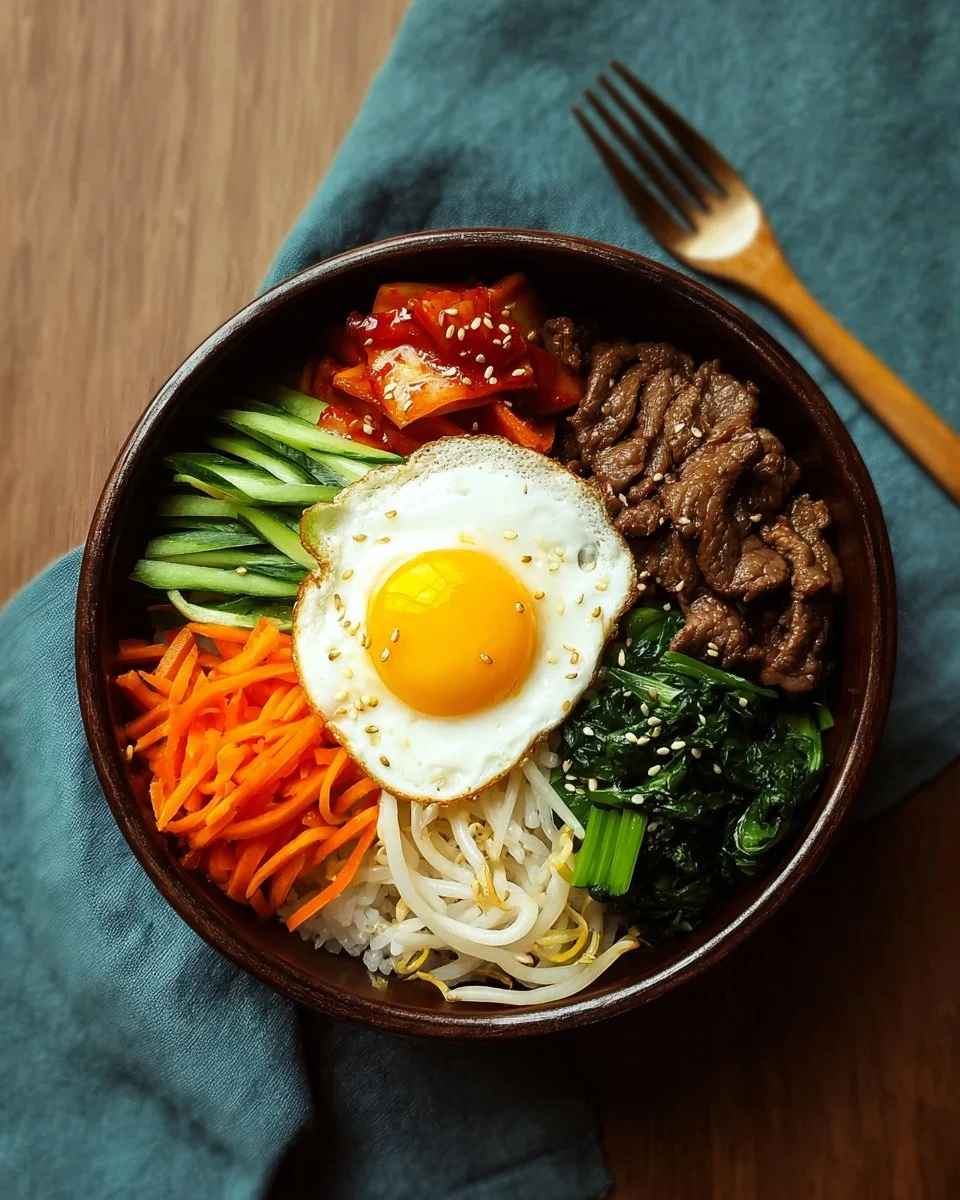
Bibimbap Recipe: Classic Korean Rice Bowl
The first bite hits you with warm sesame, sweet soy, and bright chile—fresh, loud, and comforting. Bibimbap is a layered rice bowl that balances textures: fluffy rice, crisp vegetables, savory beef, and a silky fried egg. After testing this version eight times and refining the gochujang sauce, I landed on proportions that give you heat, umami, and a clean finish every time. This is the bowl I taught junior cooks at my restaurant and the one I make for family weeknights. Below you’ll find exact measurements, timing, and simple techniques so you can build a restaurant-quality bibimbap at home. If you want a compact visual guide while you cook, check our step-by-step Korean bibimbap bowl walkthrough for plating ideas.
Why this recipe works
- Layered flavors: quick sautéing and separate seasoning of each vegetable keeps colors and textures distinct.
- Balanced sauce: a 2:1 ratio of gochujang to soy creates heat and umami without overpowering the bowl.
- Temperature contrast: hot rice under cool, vinegared greens brightens each bite.
- Simple tech: thinly slicing and blanching cut cook time while giving chewy mouthfeel.
- Tested method: multiple tests refined salt and acid so the dish tastes balanced cold or hot.
Ingredients breakdown
- Short-grain rice (500 g / 2½ cups cooked; cook 300 g (1½ cups) raw): Provides the sticky base that holds the toppings together. Use sushi or short-grain rice for proper texture; long-grain will be too loose.
- Spinach (200 g / 7 oz): Blanched and dressed with sesame oil and salt to add a silky, slightly bitter green. You can swap baby spinach for savoy, but blanching time will vary.
- Carrot (2 medium, 150 g / 1 cup julienned): Adds crunch and sweetness when quickly sautéed in neutral oil.
- Zucchini (1 medium, 150 g / 1 cup half-moons): Sautéed until just tender; keeps a fresh bite.
- Bean sprouts (200 g / 7 oz): Blanched briefly and seasoned with garlic and sesame oil for texture contrast.
- Shiitake or cremini mushrooms (150 g / 5 oz): Sliced and sautéed with soy for savory depth. Dried shiitake rehydrated in hot water gives an extra umami boost—reserve soaking liquid for the sauce if used.
- Ground beef or thinly sliced bulgogi beef (400 g / 14 oz): Seasoned with soy, sugar, garlic, and sesame oil for a savory-sweet protein. You can use tofu (see variations).
- Gochujang (60 g / 4 tbsp): Korean red chile paste — the main spicy-sweet element. Use a good-quality gochujang. If you must substitute, increase sugar slightly and add a touch of chile flakes.
- Soy sauce (30 ml / 2 tbsp): Provides umami. If using low-sodium, taste and add a pinch of salt.
- Sesame oil (15 ml / 1 tbsp): Finishing oil for aroma. Use pure toasted sesame oil sparingly.
- Garlic (3 cloves): Minced; divides between beef and vegetables.
- Sugar (15 g / 1 tbsp): Balances the chile paste and soy.
- Rice vinegar (15 ml / 1 tbsp): Brightens blanched greens and sauce.
- Eggs (4 large): Fried sunny-side up for richness. For a vegan bowl, skip and use pan-seared tofu.
- Kosher salt: I use Diamond Crystal; if using Morton’s, halve the measurement as it’s denser.
Essential equipment
- Medium saucepan with lid for rice (or rice cooker). If using a saucepan, a tight-fitting lid prevents steam loss.
- Large skillet (10–12 inch / 25–30 cm) for sautéing vegetables and mushrooms.
- Small nonstick pan for frying eggs.
- Fine-mesh sieve or blanching basket for greens and bean sprouts.
- Sharp chef’s knife and cutting board for quick, uniform slices.
- Bowls for mise en place — keep each topping separate to control seasoning.
- Optional: rice paddle and stone pot (dolsot) if you want a crispy rice layer at home. If you don’t have a dolsot, a heavy cast-iron skillet can crisp rice on the stove.
Step-by-step instructions
Makes 4 servings. Prep time 25 minutes. Cook time 30 minutes. Total time 55 minutes. Inactive time None.
Step 1: Cook the rice
Rinse 300 g (1½ cups) short-grain rice in cold water until it runs clear, drain, then combine with 420 ml (1¾ cups) water in a saucepan. Bring to a boil, reduce to low, cover, and simmer 12–14 minutes until the water is absorbed; rest covered for 10 minutes. Fluff with a rice paddle or fork before serving.
Step 2: Blanch and season spinach
Bring a pot of salted water to a boil and blanch 200 g (7 oz) spinach for 10–15 seconds until bright green and tender. Drain, squeeze gently to remove excess water, and toss with 5 ml (1 tsp) sesame oil, 1/4 tsp kosher salt, and 1/2 clove minced garlic. Chill to room temperature, about 5 minutes.
Step 3: Prepare bean sprouts and carrots
Blanch 200 g (7 oz) bean sprouts for 30–45 seconds, drain well, and season with 5 ml (1 tsp) sesame oil, 1/4 tsp kosher salt, and a pinch of minced garlic. Sauté 150 g (1 cup) julienned carrot in 10 ml (2 tsp) neutral oil for 2–3 minutes until tender-crisp; season with salt.
Step 4: Sauté zucchini and mushrooms
Slice 150 g (5 oz) zucchini into half-moons and sauté in 10 ml (2 tsp) oil for 2–3 minutes until edges are translucent and slightly browned. Sauté 150 g (5 oz) mushrooms in 10 ml (2 tsp) oil with 1/2 tbsp (7.5 ml) soy sauce for 3–4 minutes until deeply browned and fragrant.
Step 5: Cook the beef
Heat a skillet over medium-high, add 400 g (14 oz) ground beef or thinly sliced beef, 15 ml (1 tbsp) soy sauce, 1 tbsp (15 g) sugar, 1 clove minced garlic, and 5 ml (1 tsp) sesame oil. Cook, breaking up the meat as needed, for 4–6 minutes until browned and sauce has mostly evaporated. Taste and adjust seasoning.
Step 6: Make the gochujang sauce
In a bowl mix 60 g (4 tbsp) gochujang, 15 ml (1 tbsp) soy sauce, 15 g (1 tbsp) sugar, 10 ml (2 tsp) rice vinegar, 5 ml (1 tsp) sesame oil, and 1 tbsp (15 ml) warm water. Stir until smooth. Taste and adjust sweetness or heat—sauce should be spicy, sweet, and smooth.
Step 7: Fry the eggs and assemble
Heat a nonstick pan to medium and fry 4 large eggs sunny-side up until whites are set but yolks are runny, about 2–3 minutes. Divide 4 cups (about 800 g) cooked rice into bowls, arrange each topping in separate sections, add beef, place an egg on top, and drizzle 1–2 tbsp (15–30 ml) sauce per bowl. Serve hot and instruct diners to mix thoroughly.
Expert Tips & Pro Techniques
- Mistake to avoid: Overcrowding the pan steams vegetables. Cook in batches so they brown lightly for better texture.
- Knife work matters: Cut vegetables thin and uniform (3–4 mm / about 1/8 inch). That way they cook evenly and look tidy.
- Make-ahead: Prep all vegetables and the sauce up to 24 hours ahead; store each topping in airtight containers in the fridge. Reheat beef and rice before assembly.
- Professional trick for texture: Toss hot rice with 5 ml (1 tsp) sesame oil to help the grains separate and prevent clumping.
- Home adaptation of dolsot: For a crunchy rice crust, heat a heavy cast-iron skillet, press leftover cold rice into the bottom, drizzle 5 ml (1 tsp) oil, and cook on medium-low until crisp, about 6–8 minutes.
- Flavor layering: Season each vegetable lightly; the cumulative salt from many parts builds depth. Taste a small bite before final seasoning.
Storage & reheating
- Refrigerator: Store components separately in airtight containers for up to 3 days. Eggs do not keep well once fried; store them separately and add fresh if possible.
- Freezer: Cooked beef and blanched vegetables freeze okay for up to 2 months, but textures change. Freeze in single-use portions in freezer-safe bags.
- Thawing & reheating: Thaw overnight in the fridge. Reheat rice and beef in a covered skillet over medium-low for 5–7 minutes, or in a 175°C (350°F) oven for 8–10 minutes. Reheat vegetables gently to avoid overcooking. Avoid microwaving assembled bowls; it makes vegetables soggy.
Variations & substitutions
- Vegetarian: Replace beef with 400 g (14 oz) firm tofu, pressed and pan-seared, then toss with the same soy-garlic seasoning. Keep sauce the same.
- Gluten-free: Use tamari (15 ml / 1 tbsp) instead of soy sauce and ensure your gochujang is gluten-free. No other time changes.
- Spicy-sweet gochujang swap: If gochujang is too hot, use 40 g (2½ tbsp) gochujang and add 20 g (1½ tbsp) honey to balance heat. Flavor strongness changes—taste and adjust.
- Low-sodium: Reduce added soy by half and increase garlic and sesame oil for aroma; finish with a sprinkle of toasted sesame seeds for perceived saltiness.
Serving suggestions & pairings
- Traditional pickles: Serve with quick cucumber kimchi or a crisp cucumber salad for acid contrast.
- Soup pairing: A light miso or Korean doenjang soup keeps the meal balanced.
- Garnish & crunch: Toasted sesame seeds and thin strips of nori add aroma and texture.
- Beverage: A cold barley tea or light lager pairs well and refreshes the palate.
Nutrition information (per serving)
Serving size: 1 bowl. Recipe yields 4 servings.
- Calories: 610 kcal
- Total Fat: 26 g
- Saturated Fat: 7 g
- Cholesterol: 210 mg
- Sodium: 920 mg
- Total Carbohydrates: 63 g
- Dietary Fiber: 5 g
- Sugars: 12 g
- Protein: 28 g
Nutrition values are estimates. Actual values may vary based on specific ingredients and preparation methods.
Frequently Asked Questions
Q: Why did my bibimbap turn out dry?
A: Dryness usually means too little sauce or overcooked rice. Add 1–2 tbsp (15–30 ml) sauce per bowl and a drizzle of sesame oil. Use slightly less heat and fold quickly to keep moisture.
Q: Can I make this without eggs?
A: Yes. Omit eggs and add pan-seared tofu (400 g / 14 oz) or a spoonful of seasoned avocado for creaminess.
Q: Can I double this recipe?
A: Yes. Double all ingredients and cook vegetables in batches so they brown properly. Rice and beef scale linearly; increase pan size or cook in two batches to avoid steaming.
Q: Can I prepare this the night before?
A: Absolutely. Prepare all toppings and sauce up to 24 hours ahead and store them separately in the fridge. Reheat beef and rice before assembly.
Q: How long does bibimbap keep in the fridge?
A: Stored in separate airtight containers, components keep 3 days. Assembled bowls are best eaten same day.
Q: Is there a vegetarian gochujang option?
A: Most gochujang is already vegetarian, but check labels for fish-based additions. If unsure, increase sugar and add smoked paprika for depth.
Q: How do I get the crispy rice effect without a dolsot?
A: Press cold rice into a hot, lightly oiled cast-iron skillet and cook on medium-low for 6–8 minutes until golden and crisp. Flip or scrape to loosen into bowls.
Conclusion
Bibimbap is forgiving and flexible. With a little prep and these clear steps, you’ll get bright vegetables, savory protein, and a sauce that ties it all together. For more background on traditional ingredients and variations, see this detailed recipe on My Korean Kitchen’s bibimbap, and for another reliable home-cook approach, check the practical tips at RecipeTin Eats’ bibimbap.
Print
Bibimbap Recipe: Classic Korean Rice Bowl
- Total Time: 55 minutes
- Yield: 4 servings 1x
- Diet: Vegetarian with options for meat
Description
Bibimbap is a layered Korean rice bowl that balances fluffy rice, crisp vegetables, savory beef, and a silky fried egg, enhanced with a flavorful gochujang sauce.
Ingredients
- 300 g (1½ cups) short-grain rice
- 200 g (7 oz) spinach
- 2 medium carrots (150 g / 1 cup, julienned)
- 1 medium zucchini (150 g / 1 cup, half-moons)
- 200 g (7 oz) bean sprouts
- 150 g (5 oz) shiitake or cremini mushrooms
- 400 g (14 oz) ground beef or thinly sliced bulgogi beef
- 60 g (4 tbsp) gochujang
- 30 ml (2 tbsp) soy sauce
- 15 ml (1 tbsp) sesame oil
- 3 cloves garlic (minced)
- 15 g (1 tbsp) sugar
- 15 ml (1 tbsp) rice vinegar
- 4 large eggs
- Kosher salt to taste
Instructions
- Cook the rice: Rinse rice until clear, combine with water in a saucepan, bring to a boil, reduce to low, cover and simmer for 12–14 minutes, let rest covered for 10 minutes.
- Blanch and season spinach: Boil salted water, blanch spinach for 10–15 seconds, drain, squeeze excess water, toss with sesame oil, salt, and garlic.
- Prepare bean sprouts and carrots: Blanch bean sprouts for 30–45 seconds, season; sauté carrots for 2–3 minutes.
- Sauté zucchini and mushrooms: Cook zucchini until translucent; sauté mushrooms with soy sauce until browned.
- Cook the beef: Heat skillet, add beef, soy sauce, sugar, garlic, and sesame oil; cook for 4–6 minutes until browned.
- Make the gochujang sauce: Mix gochujang, soy sauce, sugar, rice vinegar, sesame oil, and warm water until smooth.
- Fry the eggs and assemble: Fry eggs sunny-side up, divide rice into bowls, arrange toppings, add beef, place an egg, and drizzle sauce.
Notes
For a vegetarian option, replace beef with firm tofu. For gluten-free, use tamari instead of soy sauce.
- Prep Time: 25 minutes
- Cook Time: 30 minutes
- Category: Main Course
- Method: Cooking
- Cuisine: Korean
Nutrition
- Serving Size: 1 bowl
- Calories: 610
- Sugar: 12g
- Sodium: 920mg
- Fat: 26g
- Saturated Fat: 7g
- Unsaturated Fat: 0g
- Trans Fat: 0g
- Carbohydrates: 63g
- Fiber: 5g
- Protein: 28g
- Cholesterol: 210mg